Social Skills Behavior Workbook: A Practical Tool for Building Emotional and Social Competence
For parents, teachers, and therapists helping children aged 5–12 develop social and emotional skills, the landscape of available resources can feel overwhelming. Between digital apps, card decks, full curricula, and activity books, choosing the right tool often depends on the child’s specific needs, the setting, and the adult’s capacity to facilitate learning. One resource that has gained attention for its focused, no‑frills approach is the Social Skills Behavior Workbook. This printable 32‑page workbook offers a structured way to work on emotional awareness, self‑regulation, communication, conflict resolution, and several other core social competencies. But how does it compare with other approaches? And when is it the right fit?
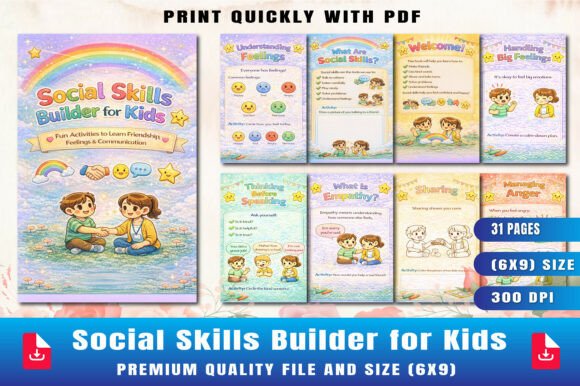
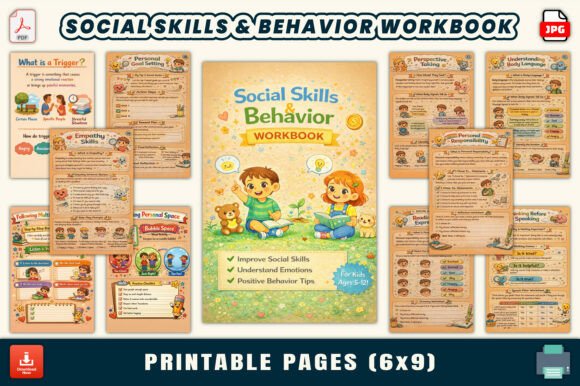
The workbook is designed as a printable JPG and PDF resource with individual pages in a 6×9 inch format. It uses a clean, black‑and‑white layout that is printer‑friendly and minimal. The content covers a wide range of skills: understanding emotions, self‑regulation strategies, impulse control, perspective taking, friendship skills, expected versus unexpected behaviors, problem‑solving strategies, and responsibility reflection. Each page includes explanations, interactive worksheets, role‑play scenarios, reflection prompts, goal‑setting pages, behavior tracking tools, and coping strategies. This combination of features makes it distinct from many single‑focus activity books or purely digital tools.
What Makes This Workbook Different?
Many social skills resources fall into one of two categories: expansive curricula that require dedicated lesson times and training, or simple coloring pages that lack depth. The Social Skills Behavior Workbook sits in the middle. It provides enough structure to guide a session but remains flexible enough for a parent to use after dinner or for a teacher to slip into a calm‑down corner.
One of its standout features is the emphasis on role‑play scenarios and reflection prompts. Instead of just describing what “good” behavior looks like, the workbook asks the child to consider real‑life situations and practice responses. For example, a page on conflict resolution might present a playground disagreement and ask the child to identify feelings and choose a solution. This active engagement is a strength when compared to passive worksheets that only require circling pictures.
The workbook is also deliberately minimal. The black‑and‑white design, lack of distracting graphics, and straightforward language keep the focus on the skills themselves. This can be especially helpful for children who are easily overstimulated by busy layouts, or for use in therapy settings where simplicity aids concentration.
Another distinguishing element is the range of skills covered. Many workbooks concentrate on emotional regulation OR friendship skills, but this resource weaves together ten distinct areas, from impulse control to responsibility reflection. That breadth can save a parent or therapist from having to purchase multiple tools for different skill domains.
Strengths and Tradeoffs of the Workbook Approach
Every resource type has inherent tradeoffs. For the Social Skills Behavior Workbook, the strengths lie in its structured simplicity, portability, and low cost. Because it is a printable PDF, you can print pages as needed, reuse them with multiple children, or focus on specific skills without wasting paper. The 32‑page length is manageable; it doesn’t feel like an overwhelming curriculum, yet it provides enough material for several weeks of regular practice.
The workbook also promotes independent thinking. The reflection prompts and goal‑setting pages encourage children to think about their own behavior, not just comply with instructions. For a 7‑year‑old working on perspective taking, a page that asks “How do you think your friend felt?” can be more impactful than a lecture.
However, there are tradeoffs to consider. The workbook is not a fully interactive digital experience. Children who are accustomed to gamified learning apps may find the printable format less engaging. The black‑and‑white design, while clean, might not capture the attention of a child who responds best to bright colors or animations.
Additionally, the workbook requires adult facilitation for most activities. While the explanations are easy to understand, a child aged 5–6 will need a parent or teacher to read prompts and guide role‑plays. Even for older children, the most valuable insights often come from discussing the reflection prompts with an adult. This is not a “hand it over and walk away” resource.
Another limitation is depth. With 32 pages covering ten skill areas, each topic receives limited pages. For a child who struggles deeply with impulse control or anger management, the workbook may serve as a starting point but not a comprehensive intervention. In such cases, a more targeted resource or professional support might be necessary.
Who Benefits Most from This Type of Workbook?
The Social Skills Behavior Workbook is particularly well‑suited for several specific scenarios:
- Parents looking for a structured home‑based resource. If you have a child between 5 and 12 who needs help with social skills but doesn’t require full‑time therapy, this workbook can be used during a weekly “skills time” or as a supplement to conversations.
- Classroom teachers managing a diverse group of learners. The black‑and‑white format makes it inexpensive to print for the whole class or for a small group in need of social‑emotional support. The role‑play scenarios can be adapted for pair work or group discussion.
- Homeschool educators integrating life skills. The workbook aligns well with the goal of teaching practical behavior skills alongside academics. The goal‑setting and tracking pages can become part of a child’s portfolio.
- Special education professionals. The clear, simple language and structured activities work well for children with autism, ADHD, or other conditions that affect social understanding. The minimal design reduces sensory overload.
- Therapists in clinic or telehealth settings. Print specific pages to use during sessions, or email the PDF to families for homework. The consistency of the format helps build routines.
For example, a therapist working with an 8‑year‑old who has difficulty reading social cues might use the “perspective taking” page to practice identifying emotions in scenarios. A parent could supplement that with the “expected vs. unexpected behaviors” page to reinforce classroom norms.
When to Consider Alternatives
While the workbook is versatile, it is not the best option for every situation. Consider other resources if any of the following applies:
- The child needs a gamified or interactive approach. Some children respond much better to digital apps that give immediate feedback, animations, or points and rewards. In that case, an online social‑emotional learning platform might be more engaging.
- You are working with older children (adolescents). The scenarios and language in the workbook seem tailored to the 5–12 range. Teenagers dealing with complex peer pressure, dating, or online etiquette will likely need materials designed for their developmental stage.
- Deep, ongoing intervention is required. If a child has significant behavioral challenges, such as aggression or severe social anxiety, a workbook alone is unlikely to be enough. A comprehensive behavior plan coordinated with a therapist or school team would be more appropriate.
- Group dynamics are the primary focus. While the workbook includes role‑play, it is designed for individual or one‑on‑one use. For teaching group social skills like taking turns in a conversation or cooperating on a team, a structured group curriculum with live practice may be more effective.
It is also worth noting that the workbook is a static resource. Unlike a curriculum that offers lesson plans, extension activities, or assessment rubrics, this is a collection of worksheets. If you need a full semester’s worth of sequenced lessons, a more comprehensive program might be worth exploring.
How to Evaluate a Social Skills Resource
When choosing between the Social Skills Behavior Workbook and other tools, consider these factors:
- Age and developmental fit. Does the resource match the child’s cognitive and emotional maturity? The workbook’s age range of 5–12 is broad, but within that range, some pages may be too simple for a 12‑year‑old or too advanced for a 5‑year‑old. Look inside to gauge.
- Skill coverage. Does the resource address the specific areas your child struggles with? If the main need is emotional vocabulary, the workbook covers that well. If the need is advanced conflict resolution in friendships, you may need supplementary material.
- Format and usability. Are you willing to print pages and sit with the child? If you prefer digital‑only or screen‑based interactions, a PDF workbook may not be ideal. On the other hand, if you want a low‑tech, distraction‑free option, this format shines.
- Cost and reusability. The printable format is cost‑effective for multiple children or repeated use. Compare the cost per page to other resources; it is typically lower than a physical book and far less than a subscription app.
- Evidence base or professional endorsement. While the workbook appears grounded in common social‑emotional learning principles (like CASEL’s framework), it is not a product of a large research institution. For clinical settings, you may want to verify that the strategies align with evidence‑based practices.
Making the Right Choice for Your Situation
The Social Skills Behavior Workbook is a strong contender for anyone who wants a low‑cost, focused, and flexible tool to introduce or reinforce social and emotional skills. Its strength is in its simplicity and breadth. It does not try to be everything, but it covers the essentials needed for many children to build confidence, emotional awareness, and positive behavior.
If you are a parent looking to start a conversation about feelings and friendship, or a teacher who needs a quick resource for a morning meeting or calm‑down corner, this workbook can fill that role effectively. If you are a therapist who wants a consistent set of worksheets for homework, this may be a practical addition to your toolkit.
However, if your child needs more intensive intervention, a gamified learning experience, or a group‑based curriculum, you will likely need to supplement or choose a different approach. The best decision comes from honestly assessing the child’s needs, your own capacity for facilitation, and the setting in which the skills will be practiced.
Ultimately, no single resource can replace the value of consistent adult support, modeling, and real‑world practice. The Social Skills Behavior Workbook can be a helpful structured companion on that journey, especially when used thoughtfully and with intention.