1000 Self-Esteem Boosting Prompts
At some point, most of us hit a wall. That internal voice shifts from supportive to skeptical, and suddenly even small decisions feel heavy. Whether you are navigating a career pivot, launching a creative project, or simply trying to show up more confidently in daily life, the ability to rebuild a steady sense of worth is foundational. 1000 Self-Esteem Boosting Prompts offers a structured, practical pathway through that inner fog—one guided question at a time.
More than a journal: a systematic confidence toolkit
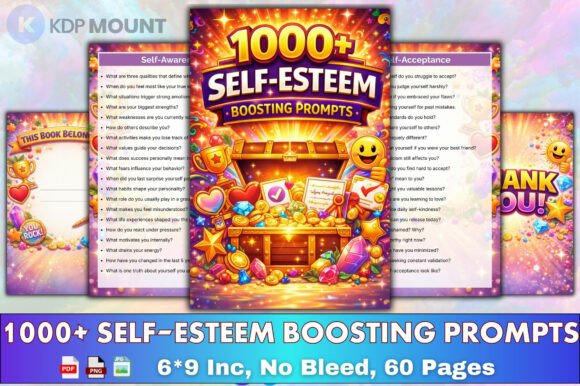
What sets this collection apart from a typical journal or self-help book is its intentional architecture. Rather than a handful of open-ended questions, you get fifty categories that span every dimension of personal growth. The prompts move from Foundation Self-Understanding to Self-Acceptance, then into Mental Strength, Emotional Mastery, Confidence and Personal Power, Growth and Achievement Mindset, and finally Relationships and Life Balance. This progression mirrors how real confidence develops: it starts with knowing yourself, then accepting what you find, and only then building outward into resilience, leadership, and social ease.
Each prompt is clear and ready to use. There is no fluff, no vague affirmations that feel disconnected from your day. Instead, the questions are designed to surface specific insights. For example, a prompt in the self-acceptance category might ask you to describe a moment when you treated yourself with unexpected kindness—and then explore what that says about your capacity for compassion. That kind of concrete reflection makes the abstract concept of self-esteem actionable.
Who benefits most from 1000 prompts
This resource is not limited to people in crisis or those new to personal development. In my experience working with professionals and creators, the individuals who gain the most are often high-functioning people who have a blind spot around their own worth. Entrepreneurs who can pitch a product but struggle to ask for what they deserve. Freelancers who deliver excellent work but underprice themselves. Managers who lead teams effectively yet second-guess every decision. The prompts serve as a kind of structured thinking partner—one that does not judge and never runs out of material.
For therapists, coaches, and educators, the collection doubles as a ready-made toolkit. Instead of spending hours crafting journaling assignments for clients or students, you can assign specific categories that match the week's growth area. A client working on boundaries can pull prompts from the relationships section. Someone recovering from perfectionism can explore the self-acceptance prompts. This versatility makes it a practical asset in clinical, educational, and coaching settings.
Real-world applications across environments
Consider the professional context. A marketer preparing for a high-stakes presentation might use a handful of social confidence prompts beforehand to quiet the inner critic and ground themselves in their actual competence. A creator facing creative block can turn to the growth and achievement prompts to separate fear of failure from genuine creative fatigue. Over time, this practice rewires the default response to pressure from I am not ready to I have evidence that I can handle this.
In educational settings, teachers and mentors can integrate prompts into advisory periods, leadership programs, or even writing workshops. The structure supports teens and young adults who may not have the vocabulary yet to articulate what they feel about themselves. By offering a question like What is one thing you did this week that took courage—even if no one noticed?, the prompts give young people a safe entry point into self-reflection.
For personal use, the daily ritual of a single prompt creates consistency without overwhelm. You do not need an hour of silence and a candle. You need three minutes and a willingness to answer honestly. That accessibility is what makes the difference between a book that sits on a shelf and a tool that actually shifts mindset.
Key characteristics that make it work
The 1000 Self-Esteem Boosting Prompts collection is built around several strengths that matter for real-world use:
- Progressive structure. The categories build on each other. You are not thrown into deep emotional excavation on page one. The sequence respects your readiness and slowly develops your reflective muscle.
- High volume, low pressure. One thousand prompts might sound like a lot, but that is the point. You never run out of fresh angles. If a particular question does not resonate, you can skip it and move to the next without guilt. The abundance lowers the stakes.
- No prior experience required. The prompts assume nothing about your background with journaling, therapy, or personal development. They are written in plain, direct language that anyone can engage with.
- Portable and flexible. Whether you prefer a paper journal, a digital document, or a voice note to yourself, the prompts adapt to your format. You can use one a day, ten in a focused session, or revisit a single category monthly to track change over time.
How to get the most out of the prompts
Effectiveness often comes down to implementation, not intention. Here are a few practical considerations drawn from observing how people integrate guided prompts into their routines:
- Start with one category. Jumping across all fifty at once dilutes the depth. Pick the area that feels most relevant right now—maybe mental strength if you are dealing with uncertainty, or self-acceptance if you are recovering from a setback. Spend two weeks there before branching out.
- Write without editing. The goal is not a polished essay. It is honest self-communication. Allow yourself to write poorly, to contradict yourself, to change your mind mid-sentence. That is where the real insight lives.
- Revisit old answers. After a few months, look back at your responses from earlier prompts. You will likely notice shifts in tone and content that objectively show growth—even on days when it does not feel that way.
- Use the Belongs Page intentionally. The collection includes a personalized starter page that makes the journal feel complete. Treat it as a small ritual. Writing your name and a short intention signals to your brain that this material matters.
Beyond self-esteem: the compound effect
Consistent engagement with these prompts tends to produce benefits that extend far beyond feeling better about yourself. Users often report improved decision-making because they trust their judgment more. Communication becomes clearer because they understand their own needs and can articulate them without apology. Professional work benefits from reduced self-sabotage—fewer hours wasted on overthinking, more energy channeled into output that actually moves the needle.
From a branding and engagement perspective, if you are a content creator, coach, or publisher, offering structured prompts like these as a lead magnet or digital product positions you as someone who provides real tools, not just inspiration. It aligns with current audience expectations for practical, no-nonsense resources that deliver measurable value. The 1000 Self-Esteem Boosting Prompts format is straightforward enough to distribute digitally, yet substantive enough to generate genuine user loyalty and word-of-mouth sharing.
A note on realism and expectations
No prompt collection can single-handedly resolve deep-seated trauma or replace professional therapeutic support. If you or someone you are working with is experiencing significant distress, prompts should supplement—not substitute—qualified care. That said, for the vast majority of people dealing with everyday self-doubt, perfectionism, and social anxiety, structured self-reflection is one of the most evidence-based, low-cost interventions available. The key is consistency over intensity. A single prompt answered honestly every day will shift your internal narrative more than a weekend retreat that you never revisit.
The design of this particular collection also accounts for different learning styles. Visual thinkers may benefit from sketching their answers. Analytical types might prefer bullet-point responses. The prompts are neutral enough to accommodate both. This flexibility is a quiet strength that makes the resource viable across different personalities and professional contexts.
Final observations
What makes 1000 Self-Esteem Boosting Prompts genuinely useful is not the quantity of questions but the care behind their sequencing and phrasing. Each prompt was crafted to guide without leading, to challenge without overwhelming. Whether you are a busy professional carving out five minutes before a meeting, an educator looking for classroom-friendly reflection tools, or someone quietly working through a difficult season, this collection offers a reliable structure for the kind of inner work that actually changes how you show up.
Confidence is not a personality trait you are born with. It is a skill you build through repeated, honest engagement with your own experience. These prompts give you a practical way to practice that skill—one question, one answer, one day at a time.