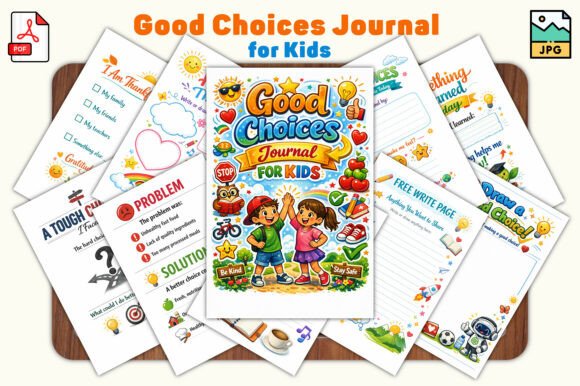
Good Choices Journal for Kids – A Practical Tool for Building Lifeskills
Every parent or educator knows the moment: a child stands at a crossroads, unsure whether to share a toy, speak up when something feels wrong, or simply choose to be kind when frustration bubbles up. These small moments are where character begins to take shape. Yet translating those lessons into daily practice can feel elusive. That is where Good Choices Journal for Kids enters the picture. Designed not as a workbook of rigid rules but as a gentle companion for reflection, this journal helps children navigate their own thoughts, feelings, and decisions in a way that feels natural and even playful.
In an age when screen time often replaces quiet reflection, a physical guided journal offers something rare: a dedicated space for a child to slow down, think, and write or draw about their day. The 📘 Good Choices Journal for Kids 🌟 Learn • Think • Choose Wisely 🌟 is built around the idea that good choices are not born from lectures but from practice, awareness, and a little bit of encouragement. This article explores what the journal offers, how it works in real life, and who might find it most valuable.
What Makes This Journal Different from Other Children’s Workbooks?
Many resources for children focus solely on academic skills or behavior management. This journal takes a different route. Rather than telling a child what to do, it invites them to explore how their choices affect themselves and others. The tone is warm, not preachy. The prompts are open-ended, allowing for drawings, short sentences, or even just a few words, depending on the child’s age and comfort level.
At its core, the journal is built around three guiding ideas: learn, think, choose wisely. These aren’t just words on a cover. They reflect a progression. A child learns about honesty, kindness, and safety through simple activities. They think about how their actions made someone feel, or what they might do differently next time. Then they choose wisely not because they were told, but because they’ve built the internal habit of reflection.
The journal’s structure supports this progression without overwhelming a young mind. With 30 pages, it’s long enough to build a consistent habit but short enough to feel achievable. Each page serves a distinct purpose, from emotion check-ins to gratitude exercises, without repeating the same format.
A Closer Look at the Features
Let’s walk through what’s actually inside. The journal begins with a bright and friendly cover page, followed by a “This Book Belongs To” ownership page. This simple detail matters: when a child writes their name, they claim the journal as their own. It becomes personal territory, not an assignment.
Then come welcome instructions pages written directly for kids. These explain, in kid-friendly language, what the journal is for and how to use it. No jargon, no complicated directions. Just a friendly invitation to start reflecting.
The daily choice-reflection prompts form the heart of the journal. These vary from page to page, encouraging children to think about a specific moment in their day. For example, a prompt might ask: “Did you make a safe choice today? What happened?” or “Think of a time you were kind. How did it feel?” The questions are concrete enough for a six-year-old to grasp, yet open enough for an older child to write a thoughtful response.
Beyond daily prompts, the journal includes dedicated pages for kind, smart, and safe choice activities. These are not theoretical exercises. They ask the child to recall actual moments from school, home, or playtime. There are emotion check-ins and feelings pages, where kids can identify how they felt during the day and connect those feelings to specific choices.
School, home, and friendship choice pages broaden the scope. A child might reflect on what happened during recess, or how they handled a disagreement with a sibling. This variety prevents the journal from feeling repetitive and covers the full range of a child’s daily life.
Gratitude and happy thoughts pages add a positive anchor. Even on tough days, finding one small thing to be grateful for can shift a child’s perspective. Creative drawing and free-write pages offer release valves: sometimes a child can’t find the words, but can draw how they feel. A notes page and a warm thank you page round out the experience, ending the journal on a note of appreciation.
Where and How the Journal Can Be Used
One of the strengths of Good Choices Journal for Kids is its versatility. It works in multiple settings, each with a slightly different approach.
At Home
Parents can use the journal as a calm evening ritual. After dinner or before bed, a child spends five to ten minutes reflecting. It’s not a chore but a quiet moment of connection. Some parents choose to sit nearby and write in their own journal, modeling the behavior. The journal becomes a bridge for conversations: “You wrote about being kind today. Want to tell me more about that?”
In the Classroom
Teachers can incorporate the journal into morning meetings or as part of a social-emotional learning (SEL) block. Because the prompts are simple and require no special materials, they fit easily into a classroom routine. The journal also works well for individual counseling sessions or as a tool for students who benefit from extra support in managing emotions.
In Counseling or Therapy
For school counselors, therapists, or child psychologists, the journal offers a structured yet flexible resource. It can be used during sessions to explore a specific incident, or assigned as a weekly practice between meetings. The emotion check-in pages and choice-reflection prompts provide concrete material for discussion.
As a Gift
Grandparents, aunts, uncles, or family friends looking for a meaningful gift often struggle to find something that’s neither a toy nor a boring book. This journal sits in a sweet spot: it’s fun, purposeful, and shows that the giver cares about the child’s growth. Pair it with a pack of colored pencils or a special pen, and it becomes a thoughtful present.
Who Benefits Most from This Journal?
While the journal is designed for kids broadly, certain groups may find it especially valuable. Children aged roughly 5 to 10 are the primary audience. Younger children can draw their responses, while older ones can write short sentences or paragraphs. The journal is also particularly helpful for kids who are developing emotional awareness, who struggle with impulse control, or who need a safe outlet for processing daily experiences.
That said, it’s not limited to children with challenges. Many kids benefit from simply having a structured moment of reflection, even if they are already doing well. The journal reinforces positive behavior and helps children recognize their own good choices, building confidence and self-awareness.
Professionals may find the journal useful as a supplement to existing SEL curricula. It doesn’t replace a comprehensive program, but it provides a personal, child-driven component that group activities sometimes miss. Business owners or creators who work in child development, parenting resources, or educational products might also consider the journal as a model for how to design simple, effective tools for young learners.
Strengths and Considerations
Let’s be honest about what this journal does well and where it has limits. Its biggest strength is accessibility. The prompts are short, the design is cheerful, and the page count is manageable. A child won’t feel daunted opening it. The variety of pages keeps things fresh, and the focus on choice, emotion, and gratitude covers the key pillars of social-emotional learning.
Another strength is the emphasis on ownership. The journal doesn’t ask for right or wrong answers. It asks for honest responses. That freedom encourages authenticity. When a child writes “I was mean to my friend today and I feel bad,” that is a breakthrough moment, not a failure. The journal creates space for those moments without judgment.
On the consideration side, the journal is 30 pages long. For some children, that might feel too short, especially if they enjoy writing or drawing extensively. Others might prefer more pages with different types of prompts. It’s also worth noting that the journal is best used with adult guidance, at least initially. A parent or teacher may need to explain the prompts and help a child get started. Once the routine is established, most kids can use it independently.
Additionally, the journal assumes a certain level of literacy or adult support. Very young children or those with reading difficulties will need help understanding the prompts. This is not a limitation so much as a design choice, but it’s worth keeping in mind when considering the journal for a particular child.
Evaluating Suitability for Different Needs
When deciding whether Good Choices Journal for Kids is right for your situation, consider a few questions. What is the child’s age and reading level? A five-year-old will use it differently than a ten-year-old. Both can benefit, but the approach will differ. What is the child’s temperament? A child who loves drawing will enjoy the creative pages. A child who prefers writing will gravitate toward the prompts. The journal accommodates both.
Also think about the setting. In a classroom, the journal works best with a routine. If a teacher can dedicate a few minutes each day, it becomes a habit. At home, consistency matters too. The journal is not a one-time fix; it’s a practice. The more regularly it’s used, the more value it provides.
For professionals, consider how the journal aligns with your existing tools. It fits well with SEL frameworks, growth mindset approaches, and positive behavior interventions. It doesn’t require specialized training, which makes it easy to implement. Business owners or creators looking for inspiration might study how the journal balances structure with freedom, a lesson that applies to many educational products.
Final Thoughts
Helping children learn to make good choices is one of the most important tasks parents, educators, and caregivers face. Yet it’s also one of the most nuanced. A journal like this doesn’t replace conversation, modeling, or guidance. What it does is give a child a private, quiet space to think about their own actions and feelings. That small act of reflection, repeated over time, builds the internal muscle of self-awareness.
Good Choices Journal for Kids is a straightforward, thoughtfully designed tool that meets children where they are. Whether used at home, in school, in counseling, or as a gift, it offers a gentle nudge toward kindness, honesty, and wise decision-making. The prompts are simple, the tone is warm, and the pages are inviting. For anyone looking to support a child’s emotional growth in a concrete, enjoyable way, this journal is well worth considering.
Every day brings new opportunities to make good choices. This journal simply helps children notice them.