Happy Little Journal for Kids: A Gentle Path to Emotional Growth and Creative Expression
In a world that moves faster every day, helping children slow down, reflect, and express themselves is more important than ever. Parents and educators are constantly searching for simple, effective tools that nurture a child's inner world without feeling like homework or a chore. Happy Little Journal for Kids steps into that space with a warm, inviting approach that feels less like an assignment and more like a daily moment of sunshine. Designed for young minds, this journal blends creativity, gratitude, kindness prompts, and emotional check-ins into one compact, easy-to-use format. Whether your child is just learning to write or already loves doodling and storytelling, this journal offers a structured yet flexible outlet for their thoughts and feelings.
What makes this journal stand out is how it balances freedom with gentle guidance. Children aren't asked to fill in long paragraphs or answer complex questions. Instead, the pages invite them to draw, color, check in with their mood, and jot down happy thoughts. It’s a tool that grows with them, supporting emotional literacy long before they have the vocabulary to talk about big feelings. And because it’s designed with a clean white background and a child-friendly layout, the focus stays on the child’s own creativity, not on distracting graphics or overwhelming clutter.
What You Will Find Inside the Happy Little Journal for Kids
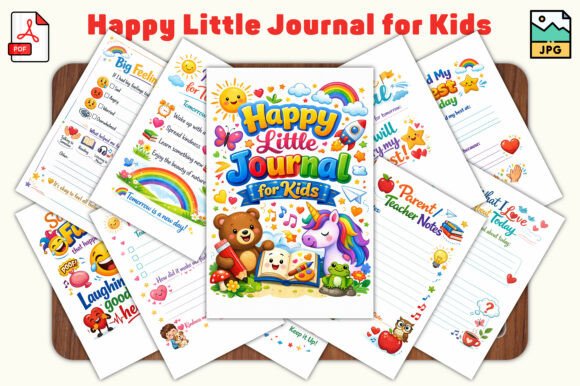
Every page in Happy Little Journal for Kids has been crafted with intention. The journal includes 30 pages of thoughtfully designed activities that encourage children to explore their emotions, celebrate their wins, and practice kindness. The journey begins with a “This Book Belongs To” page that instantly gives the child a sense of ownership and pride. From there, the “Welcome” and “How to Use This Journal” pages gently guide both the child and the parent into the journaling habit without pressure or rigid rules.
One of the most powerful features is the Daily Feelings Mood pages. These pages give children a safe, simple way to check in with themselves each day. Instead of asking “How was your day?” which often gets a one-word answer, the mood pages invite a visual and emotional response. A child can circle a face, color in a mood, or draw how they are feeling. Over time, this builds emotional vocabulary and helps children recognize patterns in their own feelings.
The Gratitude Happy Thoughts pages are equally valuable. Research consistently shows that practicing gratitude boosts happiness and resilience in children. These pages ask kids to think about what made them smile, what they are thankful for, or who helped them that day. It’s a small habit that rewires the brain toward positivity, and when done regularly, it becomes a natural part of a child’s mindset.
For the naturally creative child, the Drawing Creative pages offer an open canvas. Here, there are no prompts, just space to imagine. Some children will draw their favorite animal, others will sketch their family, and some will create fantastical scenes from their imagination. This free-form creative time is essential for cognitive development and emotional regulation. It allows children to process their world in a language they instinctively understand: art.
Rounding out the journal are the Kindness Goal-setting prompts and Reflection Proud Moments pages. These sections teach children to set small, achievable goals—like helping a friend or cleaning up without being asked—and then reflect on what made them proud. This builds self-efficacy and a sense of accomplishment that is entirely self-directed. Finally, a Parent Teacher Notes page creates a bridge between home and school, and a sweet Thank You Page at the end closes the experience with a note of appreciation and closure.
Why Emotional Learning Matters More Than Ever
Children today face a unique set of pressures. From academic expectations to social dynamics and screen time overload, their emotional landscape is complex. Tools like Happy Little Journal for Kids provide a counterbalance. They offer a quiet, analog space where kids can process their day without judgment. The journal doesn't correct, grade, or critique. It simply listens. And for a child, being listened to—even by a journal—is profoundly validating.
Emotional learning isn’t just about handling difficult feelings. It’s also about recognizing joy, celebrating small victories, and understanding that every day holds something good. The journal’s structure reinforces this by guiding children toward gratitude and kindness while leaving plenty of room for whatever they want to express. This dual focus—structured prompts plus open-ended creativity—makes it suitable for a wide range of ages, from early elementary to pre-teen years.
Parents often report that using the journal together becomes a cherished ritual. Sitting down for five minutes at the end of the day to fill in a mood or draw a happy thought creates a natural conversation starter. It’s a way to connect without interrogating, to check in without prying. Over time, the journal becomes a record of a child’s inner world—a keepsake that families treasure long after the pages are filled.
Practical Benefits for Modern Families and Classrooms
The Happy Little Journal for Kids is designed with real-world use in mind. At 6 × 9 inches, it’s small enough to fit in a backpack or tote bag but large enough for little hands to write and draw comfortably. The 30-page count is approachable—not so long that it feels overwhelming, but long enough to establish a meaningful routine. The clean, white background keeps distractions minimal, which is especially helpful for children who struggle with focus or sensory overload.
For parents, the journal fits naturally into a variety of daily scenarios. Some use it as a morning activity to set a positive intention for the day. Others use it as an after-school wind-down tool, helping children transition from the busyness of school to the calm of home. Still, others incorporate it into bedtime routines as a way to reflect on the day and end on a grateful note. The journal’s flexibility means it works for all these use cases without feeling forced.
In classrooms, teachers have found the journal useful for morning meetings, quiet time, or as a social-emotional learning station. The prompts align well with common SEL (Social Emotional Learning) goals, such as identifying emotions, practicing gratitude, setting goals, and recognizing personal strengths. Because the journal pages are reproducible in spirit (the included PDF files allow for easy printing), teachers can use individual pages as handouts or incorporate them into lesson plans. The included high-quality JPG and print-ready PDF formats make it simple to print at home or at a local copy shop.
How the Design Supports Independent Use
One of the most thoughtful aspects of Happy Little Journal for Kids is how it encourages independence. The layout is intuitive. Even a child who is just beginning to read can navigate the pages with minimal help. The mood pages use simple faces and checkboxes. The gratitude pages offer space for both writing and drawing, so children who aren’t yet confident writers can still participate fully. The goal-setting and reflection pages use clear, encouraging language that feels supportive rather than demanding.
This independence is empowering. When a child completes a page on their own, they feel a sense of accomplishment that boosts their confidence. They begin to see themselves as someone who can manage their feelings, set goals, and recognize their own happiness. This self-awareness is a gift that pays dividends throughout their life, influencing how they handle challenges, build relationships, and pursue their passions.
The journal also respects that not every day is the same. Some days a child will want to draw extensively. Other days they might just circle a mood and move on. There is no pressure to fill every page perfectly or to write a certain amount. This flexibility honors the child’s current emotional state and prevents journaling from becoming a source of stress. It’s a gentle companion, not another task on a to-do list.
Who Will Benefit Most from This Journal
While Happy Little Journal for Kids is designed for a broad age range, it shines brightest with children between the ages of 4 and 10. At the younger end, parents will need to read prompts aloud and help with writing, but the drawing and mood pages are fully accessible. At the older end, children can use the journal independently and may enjoy adding more detailed reflections. The journal also works well for children who are shy, anxious, or have difficulty expressing themselves verbally. The combination of visual and written prompts gives them multiple ways to communicate.
Parents who are passionate about gentle parenting, attachment-based care, or mindfulness will find this journal aligns perfectly with their values. It offers a screen-free, low-pressure way to teach emotional intelligence without lectures or worksheets. It’s also an excellent tool for children who are navigating a big life change—like starting a new school, welcoming a sibling, or moving to a new home. The journal provides continuity and stability during times when a child’s world feels uncertain.
Therapists and counselors who work with children have also found value in the journal’s design. The mood pages, in particular, can be used as a therapeutic tool to help children articulate feelings they might not otherwise share. The kindness and gratitude prompts build resilience and shift focus toward positive experiences, which is especially helpful for children dealing with anxiety or low mood. While the journal is not a replacement for professional support, it is a wonderful complement to therapeutic work.
Building a Lasting Habit of Self-Reflection
The ultimate goal of Happy Little Journal for Kids is not just to fill 30 pages, but to plant a seed. When children practice gratitude, check in with their feelings, and celebrate their strengths on a regular basis, they build neural pathways that support lifelong emotional health. The journal makes this practice easy and enjoyable, so it doesn’t feel like a chore. Many children finish the 30 pages and ask for another journal or start creating their own pages. That kind of organic enthusiasm is exactly what parents and educators hope to see.
For families, the journal also becomes a beautiful keepsake. Years later, flipping through the pages reveals a time capsule of childhood—the things that made a child laugh, the drawings they were proud of, the goals they set, and the people they loved. It’s a record of growth that is far more personal than a photo album or a video. It captures the inner life of a child in their own words and colors.
In a culture that often emphasizes productivity and achievement, the Happy Little Journal for Kids reminds us that a child’s emotional world deserves just as much attention as their grades or extracurriculars. It offers a quiet, joyful space for children to be exactly who they are, every single day. And that is a gift that keeps on giving long after the last page is filled.