Stop Overthinking Workbook: A Strategic Tool for Mental Clarity and Better Decisions
Overthinking is not simply a personal struggle—it is a professional liability. For entrepreneurs, marketers, creators, and decision-makers, the habit of replaying scenarios, second-guessing choices, and spiraling into “what-ifs” directly erodes productivity, creativity, and strategic clarity. The Stop Overthinking Workbook addresses this challenge not as a vague self-help gesture but as a structured, actionable resource designed to help you regain control over your cognitive environment.
This guided journal offers a systematic approach to identifying thought patterns, separating factual concerns from imagined fears, and building daily practices that reduce mental noise. When used intentionally, it becomes more than a journal—it becomes a decision-support system for your mind.
What the Stop Overthinking Workbook Actually Provides
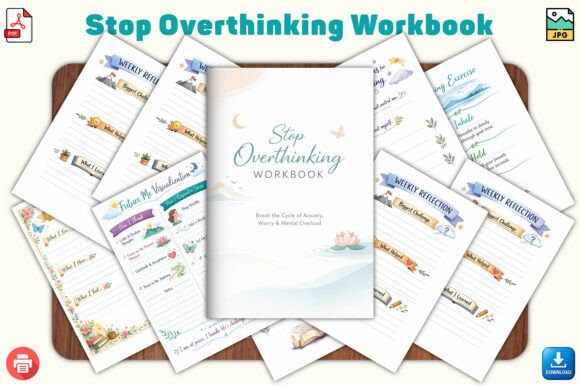
At first glance, the workbook appears to be a collection of calming exercises and reflective prompts. But beneath its minimal layout lies a carefully designed framework for cognitive restructuring. The 37 pages are organized to move you from awareness to action, with tools such as thought dump logs, fact-versus-fear reframing exercises, the 5-4-3-2-1 grounding technique, breathing and visualization practices, and progress trackers for mood and sleep.
Each component serves a distinct strategic purpose:
- Thought dump and worry logs externalize mental clutter, freeing working memory for higher-order thinking.
- Cognitive reframing exercises train your mind to distinguish between evidence-based concerns and narrative-driven anxiety.
- Grounding techniques provide immediate intervention when overthinking threatens to derail focus.
- Affirmations and self-reflection pages reinforce new mental habits over time.
- Trackers and checklists create accountability and measurable progress.
For anyone whose work depends on clear judgment—whether you are launching a product, writing a campaign, or managing a team—these are not peripheral wellness add-ons. They are operational tools for maintaining mental bandwidth.
Why Strategic Thinkers Should Pay Attention to Overthinking
The cost of overthinking is rarely accounted for in planning documents or project timelines. Yet it manifests everywhere: in delayed decisions, over-engineered solutions, avoidance of critical conversations, and the slow erosion of confidence. When your mind is caught in a loop, you cannot accurately assess risk, prioritize tasks, or communicate with clarity.
The Stop Overthinking Workbook does not promise to eliminate all ambiguity—that would be unrealistic. Instead, it helps you contain and channel your thinking so that analysis does not become paralysis. For professionals who must make decisions under uncertainty, this distinction is crucial. The workbook offers a structured exit ramp from rumination, allowing you to return to action with renewed focus.
Supporting Better Goals and Planning
Planning requires both vision and detachment. Overthinking clouds vision by introducing too many variables and hypothetical obstacles. When you use the workbook’s end-of-day reflections and weekly reviews, you create a habit of stepping back from the noise. This reflective distance is essential for sound strategic planning. You learn to separate the signal from the noise, identify what truly matters, and allocate your mental energy accordingly.
For example, a marketing professional planning a campaign might use the fact-versus-fear exercise to test assumptions about audience response. Instead of spiraling into worry about whether the messaging will land, they document the actual data points they have, name the fears that are not supported by evidence, and then proceed with a clearer strategy. The workbook does not replace market research—but it ensures that your interpretation of that research is not distorted by anxiety.
Enhancing Creativity and Communication
Creativity thrives in a mind that is open, curious, and unburdened. Overthinking contracts the mind, narrowing possibilities and reinforcing repetitive patterns. The workbook’s grounding and visualization practices help reset your cognitive state, making space for new connections and original ideas. When you are not preoccupied with internal chatter, you can listen more attentively, write more authentically, and respond to others with greater presence.
For content creators, educators, and communicators, this is a direct advantage. Your ability to produce work that resonates depends partly on your ability to be fully present to your material. The Stop Overthinking Workbook does not generate ideas for you—it clears the stage so that your ideas can emerge.
How to Use the Workbook Intentionally, Not Randomly
The most common mistake people make with any journal or workbook is to treat it as a passive activity—something to do when they feel like it, without clear intention. If you open the Stop Overthinking Workbook only when you are already overwhelmed, you may find it helpful, but you will miss its deeper value. The real power lies in consistent, goal-oriented use.
Consider integrating it into your existing workflow:
- Start your day with a thought dump before planning your top three priorities. This clears mental clutter before it accumulates.
- Use the grounding technique during transition moments—between meetings, before a difficult conversation, or after receiving unexpected feedback.
- Schedule a weekly end-of-day reflection to review not just what you accomplished, but what mental patterns helped or hindered you.
- Pair the sleep tracker with a brief breathing practice before bed. Overthinking is often worst at night; a structured unwind can protect your rest and your next day’s clarity.
The workbook is designed to be used in short, focused sessions. You do not need to complete it linearly. If you are in the middle of a high-stakes project, the cognitive reframing pages may be more useful than the introductory awareness sections. Let your current context guide your entry points.
When to Rely on the Workbook—and When Not To
The Stop Overthinking Workbook is most effective for managing moderate, persistent overthinking that stems from stress, perfectionism, or information overload. It is not a substitute for clinical support for severe anxiety, chronic insomnia, or trauma. If your overthinking is accompanied by prolonged distress or functional impairment, please seek professional help.
However, for the everyday mental noise that slows you down and clouds your judgment, this workbook is an excellent first-line resource. It gives you a structured method to intervene in your own thought processes without needing external facilitation. That autonomy is valuable for busy professionals who cannot always step away for therapy or coaching sessions.
Potential Risks of Using the Workbook Without Clear Goals
No tool is risk-free, and the Stop Overthinking Workbook can be misused. If you approach it without any sense of what you want to change, you may end up simply documenting your worries without resolution. The act of writing can reinforce rumination if it is not paired with a reframing or action step. That is why the workbook includes exercises that explicitly move you from dumping thoughts to evaluating them.
Another risk is over-reliance on the workbook itself. If you begin to feel that you cannot think clearly without it, you may have traded one dependency for another. The goal is to internalize the techniques so that eventually you need the workbook less, not more. Use it as training wheels for your mind, not as a permanent crutch.
To mitigate these risks, set a clear intention before you begin. Ask yourself: What specific thinking pattern do I want to change? How will I know if this workbook is helping? What will I do differently in my work or life as a result? Write your answers on the first page and revisit them at regular intervals.
Long-Term Value: Building Mental Habits That Last
The Stop Overthinking Workbook is not a one-time fix. Its real return on investment comes from repeated, deliberate use over weeks and months. As you cycle through the exercises, you will notice patterns in your thinking that were previously invisible. You will become faster at recognizing when you are slipping into unproductive loops. You will develop automatic responses—a deep breath, a grounding technique, a quick reframe—that interrupt overthinking before it gains momentum.
Over time, this shifts your relationship with uncertainty. You stop expecting certainty and start operating effectively within ambiguity. That is a foundational skill for anyone who leads, creates, or builds. The workbook is a practice field for exactly that skill.
Connecting to Long-Term Goals and Operations
For entrepreneurs and business owners, mental clarity is not a luxury—it is an operational necessity. Every decision, from product positioning to customer experience, is filtered through your mental state. When your mind is clear, you notice opportunities that you would otherwise miss. You communicate with your team more transparently. You make faster, better decisions because your cognitive resources are not consumed by internal conflict.
The Stop Overthinking Workbook can be integrated into your weekly operational review. Use it before strategic planning sessions to ensure you are approaching the work with a calm, focused mind. Use it after major milestones to reflect on what you learned and what you can let go of. Over time, it becomes part of your infrastructure for sustained high performance.
Practical Guide: Getting Started with Purpose
If you decide to use the workbook, begin with a small commitment. Set aside ten minutes each morning for one week. Use only the thought dump page and one grounding exercise. Observe how your day feels different. If the practice adds value, expand it. If it feels forced, adjust the timing or the exercise you choose.
Here is a sample approach for a busy professional:
- Monday–Friday: 5-minute thought dump before starting work. 3-minute breathing exercise before lunch.
- Saturday: Weekly end-of-day reflection and review of mood and sleep trackers.
- Sunday: Affirmations and self-reflection page to set intention for the coming week.
This rhythm is sustainable, low-pressure, and yields cumulative benefits. You are not trying to “fix” yourself. You are training a skill, just like any other professional competency.
Final Observation: The Workbook as a Strategic Asset
The Stop Overthinking Workbook is, at its core, a tool for reclaiming cognitive sovereignty. In a world that constantly demands your attention, worries your peace, and accelerates your thinking, having a structured method to slow down and discern is immensely valuable. It will not make you immune to stress or uncertainty, but it will give you a reliable process for navigating them.
For the adults aged 20 to 50 who are building businesses, creating content, educating others, or leading teams, this is not a luxury item. It is a practical investment in your most important resource: your mind. Use it with intention, evaluate your progress honestly, and let it support the clear, deliberate thinking that your work demands.