Inner Child Workbook
If you have ever tried to create a healing journal, a self-discovery workbook, or a therapy-adjacent printable from scratch, you already know how quickly it can become overwhelming. You want the content to be meaningful, the design to feel warm and professional, and the layout to actually work for the person using it. That is exactly where the Inner Child Workbook concept steps in—not just as a set of pretty pages, but as a thoughtfully structured tool that blends self-reflection with practical planning. And when you add a fully customizable Canva KDP interior template into the mix, you get something rare: a resource that saves time without sacrificing your creative control.
But here is the thing—many people jump into buying or creating an inner child workbook without fully understanding what they are getting, what they really need, or how to use the template effectively. The result is often a product that looks fine but fails to connect, or a workbook that sits unused because it does not fit the intended audience. Let us walk through the most common pitfalls and, more importantly, how to avoid them so that your inner child workbook actually works.
What the Inner Child Workbook Actually Is
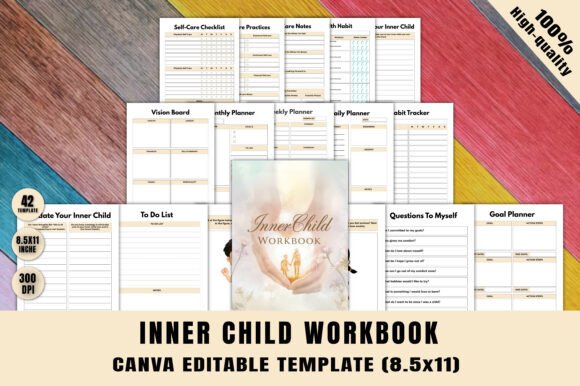
At its core, an inner child workbook is a guided journaling and reflection tool designed to help adults reconnect with the parts of themselves that formed during childhood. It is not about regressing or blaming. It is about understanding patterns, validating past experiences, and reparenting yourself with kindness. The Inner Child Workbook template available on Canva with KDP-ready formatting takes this concept and turns it into a structured, print-ready product that includes validation pages, habit trackers, self-care checklists, planners, vision boards, and goal-setting sheets.
People are drawn to this because it promises both emotional depth and practical structure. But that combination is also where most misunderstandings happen.
Mistake 1: Treating It Like a Generic Journal
The most common error I see is assuming that any pretty journal template can serve as an inner child workbook. That could not be further from the truth. An inner child workbook is not just a collection of lined pages with decorative headers. The specific pages in the template—such as the Validate Your Inner Child section, the Questions to Myself prompts, and the Self-Care Practices pages—are designed with a psychological framework in mind. If you strip those out or replace them with generic content, you lose the therapeutic coherence that makes the workbook valuable.
How to avoid this: Before you customize anything, study the existing page structure. Understand why each page exists. The Health Habit Tracker and Self-Care Checklist are not filler—they are tools for building consistency in self-care, which supports inner child work. If you change the prompts, keep the intention intact.
Mistake 2: Overlooking the Power of Customization
Paradoxically, the opposite mistake is also common: leaving the template exactly as it is. The template is 100% editable in Canva for a reason. If you publish it without changing colors, fonts, or the tone of the prompts to match your brand or your audience, it will feel generic. Readers can tell when a workbook was not tailored for them.
Better approach: Use the customization freedom to align the workbook with your specific niche. For example, if your audience is therapists and coaches, keep the language professional and warm. If you are creating for a general wellness audience, soften the tone and use inviting colors. The template gives you 34 unique pages—use them as a foundation, not a finished product.
Mistake 3: Ignoring Print and Digital Readiness
This one is particularly painful because it is completely avoidable. The template comes with print-ready, high-quality PDF files at 300 DPI, standard letter size 8.5 x 11, and no-bleed layout. Yet many people still upload files to KDP without checking resolution, margins, or whether the PDF is flattened correctly. The result? Blurry text, cut-off edges, or colors that look different on paper than on screen.
What to check before publishing: Always download the print-ready PDF from Canva and open it at 100% zoom. Check that no text falls outside the safe area. If you add new elements, make sure they are at least 300 DPI. The template is KDP-ready, but your customizations can introduce issues if you are not careful.
Mistake 4: Misunderstanding the Audience
The Inner Child Workbook is not just for people in therapy. It is for anyone who wants to understand their emotional patterns, improve self-care, or build healthier habits. The audience includes entrepreneurs, creators, bloggers, educators, freelancers, small business owners, and hobbyists—adults aged 20 to 50 who are looking for practical tools for personal growth. But many creators assume the workbook is only for people with trauma, which limits its reach and can even make the content feel too heavy for a general audience.
Better framing: Position the workbook as a self-care and self-discovery tool that anyone can use. The habit trackers, planners, and vision board pages make it approachable. You do not need to have a painful childhood to benefit from validating your inner child. This broadens your audience and makes the product more accessible.
Mistake 5: Skipping the Planning Phase
It is tempting to open the Canva template and start editing immediately. But without a plan for how you want the workbook to flow, you risk creating a disjointed experience. The template has a logical structure: it starts with ownership, moves into validation and self-care, then into planning and goal-setting, and ends with reflection and gratitude. If you rearrange pages arbitrarily or cut sections without thought, the reader may feel lost.
Practical advice: Before you edit, map out the user journey. Decide which pages are essential for your version and which you can leave out. The template includes 34 pages, but you do not have to use every single one if it does not fit your vision. However, if you remove the Validate Your Inner Child pages, you are no longer offering an inner child workbook—you are offering a planner. Be intentional.
Mistake 6: Underestimating the Value of Trackers and Planners
Some people think that habit trackers and daily planners dilute the emotional depth of an inner child workbook. I used to think that too—until I realized that healing does not happen in a vacuum. Inner child work is not just about sitting with your feelings; it is about building new patterns of self-care. The Daily Planner, Weekly Planner, Monthly Planner, and Habit Tracker are not distractions—they are the scaffolding that supports lasting change.
Why this matters: A reader might have a powerful emotional breakthrough on the Validate Your Inner Child page, but if they do not have a way to integrate that insight into their daily life, it fades. The planners and trackers bridge that gap. When you present the workbook, explain this connection. It makes the product more credible and useful.
Mistake 7: Ignoring the Visual Consistency
Because the template is fully editable, it is easy to mix fonts, colors, and styles that clash. Even if each individual page looks fine, a lack of visual consistency can make the workbook feel chaotic. This is especially important for a healing tool—the design should feel calming and cohesive, not jarring.
How to stay consistent: Choose a color palette of two to three main colors and stick with it throughout. Use no more than two fonts—one for headings and one for body text. Canva makes this easy with its style tools, but you have to exercise discipline. A cohesive design builds trust and makes the reader feel safe.
Mistake 8: Forgetting the Thank You Page
Yes, really. The template includes a Thank You Page, and it is one of the most overlooked elements. A simple thank you at the end of a workbook creates a sense of closure and appreciation. It may seem small, but it leaves a lasting impression. Many creators remove it to save space or because they think it is unnecessary. That is a missed opportunity.
Better move: Keep the thank you page and personalize it. Add a short note, your website, or an invitation to leave a review. It costs nothing and adds a professional finishing touch.
What to Look For Before You Buy or Use the Template
If you are considering purchasing the Inner Child Workbook Canva KDP interior template, here is a quick checklist to ensure you are making a sound decision:
- Check the page count: The template includes 34 unique pages. Verify that this aligns with your publishing goals. If you need more or fewer pages, plan your edits accordingly.
- Confirm file formats: You get editable Canva link, print-ready PDF, high-resolution JPG, and PNG files at 300 DPI. Make sure your workflow supports these.
- Review the page types: Make sure the mix of validation pages, trackers, planners, and notes matches what your audience needs. If you want more journaling space, the Notes pages give you two pages to expand.
- Test the editability: If you are not familiar with Canva, spend a few minutes testing how easy it is to change colors and text. The template is designed to be user-friendly, but you should feel comfortable before committing.
- Look at the layout: Standard letter size 8.5 x 11 with no bleed is ideal for KDP. Confirm that your trim size matches and that you understand how to export without issues.
Putting It All Together
The Inner Child Workbook template is a powerful starting point, but it is not a magic solution. The difference between a workbook that sits in a drawer and one that genuinely helps people lies in how you customize it, how well you understand your audience, and how carefully you handle the technical details. Avoid the common mistakes outlined here, and you will have a product that is not only beautiful but also deeply useful.
Whether you are a therapist, a coach, a content creator, or someone publishing your first KDP product, take the time to treat this template with the care it deserves. Your readers—and their inner children—will thank you.