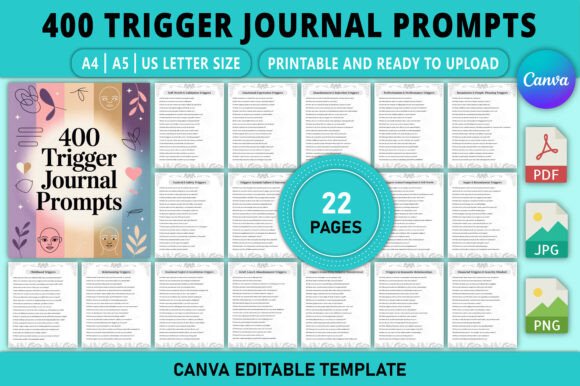
Editable 400 Trigger Journal Prompts: A Comprehensive Tool for Self-Discovery and Healing
In an era where mental health awareness is growing rapidly, more people are turning to structured self-reflection tools to navigate their inner worlds. The Editable 400 Trigger Journal Prompts collection offers a versatile, deeply practical resource for anyone committed to understanding their emotional triggers, patterns, and responses. This isn't just another journal—it’s a fully customizable workbook that adapts to your unique healing journey, whether you’re a therapist guiding clients, a coach building resources, or an individual exploring shadow work and personal growth.
What sets this collection apart is its blend of depth and flexibility. With 400 prompts spanning 18 core trigger categories, it addresses the nuanced ways our past and present experiences shape our reactions. From childhood triggers to workplace stress, financial scarcity to body image, each prompt invites honest exploration without forcing a one-size-fits-all approach. And because it’s editable in Canva, you can tailor every detail—fonts, colors, layouts, even the wording—to match your brand, your audience, or your personal aesthetic.
Why Trigger Journaling Matters Now More Than Ever
Journaling has long been a cornerstone of therapeutic practice, but the conversation around triggers has evolved. Years ago, triggers were often discussed in narrow clinical contexts. Today, we recognize that triggers are woven into everyday life: a tone of voice, a financial setback, a comparison on social media. They are signals, not weaknesses. By naming and exploring them through journal prompts, we transform emotional reactivity into self-awareness.
Current trends in wellness and personal development emphasize proactive self-care—not just treating symptoms but understanding their roots. The Editable 400 Trigger Journal Prompts workbook aligns perfectly with this shift. It moves beyond generic gratitude lists into targeted inquiry. For many adults juggling careers, relationships, and internal pressures, having a structured yet adaptable tool can be the difference between feeling stuck and making meaningful progress.
Professionals in therapy, coaching, and education are also seeking resources that can be customized for diverse clients. Off-the-shelf journals may not address specific trauma histories or cultural contexts. With this editable workbook, a therapist can adjust language to suit a neurodivergent client, or a coach can align prompts with a specific program’s philosophy. That level of personalization meets a growing demand for inclusive, adaptable mental health tools.
The Shift from Static Journals to Flexible Digital Workbooks
Traditional printed journals are beautiful, but they have limitations: once printed, you cannot change the prompts, order, or design. The rise of digital customization, especially through platforms like Canva, has revolutionized how we create and use self-help resources. The Editable 400 Trigger Journal Prompts collection is part of this evolution, offering a printable workbook that you can edit before printing—or keep entirely digital.
This flexibility addresses a practical reality: no two healing journeys are identical. One person may need to spend weeks on abandonment and rejection triggers, while another might resonate more with boundaries and people-pleasing. With an editable document, you can reorganize sections, duplicate prompts, or add journaling space as needed. You can also choose print sizes (A4, A5, US Letter) to suit your preferred notebook format, making it easy to bring into therapy sessions, coaching calls, or quiet morning routines.
For creators and entrepreneurs, this represents a shift in how they deliver value. Rather than selling a one-off product, they can offer a resource that buyers can personalize—increasing perceived value and long-term engagement. The workbook becomes a collaborative tool between the creator and the user, fostering a deeper connection.
For Therapists and Mental Health Professionals
If you work with clients who struggle to articulate their emotional triggers, this collection can be a bridge. The prompts are designed to uncover hidden patterns without leading the client toward any particular conclusion. Categories like Anger Resentment Triggers, Emotional Neglect Invalidation Triggers, and Grief, Loss & Abandonment Triggers provide a safe framework for exploration. You can assign specific sections as homework, then discuss insights in session. The editable format allows you to remove or simplify prompts for clients who may feel overwhelmed, ensuring the tool grows with their readiness.
For Coaches and Wellness Educators
Coaches often work with clients on mindset shifts, accountability, and goal attainment. But underlying triggers can sabotage progress. By integrating prompts from categories like Self-Worth Validation Triggers or Perfectionism Performance Triggers, you help clients connect present struggles to deeper fears. The Canva editability means you can add your branding, insert extra resources, or create a version tailored to a specific program (e.g., financial abundance coaching using the Financial Triggers & Scarcity Mindset section).
For Individuals on a Self-Healing Journey
Working through trigger prompts alone requires courage and structure. The 400 prompts are organized to prevent you from bouncing aimlessly between topics. You might start with Childhood Triggers to explore family dynamics, then move to Identity & Belonging Triggers as you examine who you are today. The editable nature lets you adjust the sequencing or add reflection questions that arise from your own experience. Because the prompts are printed or viewed in your chosen format, they become a constant companion—not a digital distraction.
For Creators and Entrepreneurs Building a Brand
If you run a blog, an Etsy shop, or a therapy practice website, offering a branded trigger journal can set you apart. The editable Canva template allows you to customize every visual element: your logo, color palette, typography, and even cover design. You can sell it as a digital download or print-on-demand, knowing that each customer can further personalize it. This appeals to a market that values both quality and individuality.
Inside the Workbook: Targeted Categories for Deeper Work
The 400 prompts are organized into 18 categories, each addressing a distinct area of emotional life. Here’s a look at some of the most relevant for adults navigating modern stressors:
- Childhood Triggers – Uncover how early experiences influence current reactions. Prompts encourage gentle exploration of memories without retraumatization.
- Relationship Triggers – Examine patterns in friendships, family dynamics, and romantic partnerships. Useful for anyone working on attachment styles or communication.
- Control & Safety Triggers – For those who feel anxious when plans change or when they perceive a lack of security. These prompts help distinguish between real threats and perceived loss of control.
- Emotional Expression Triggers – Explore why certain emotions (anger, sadness, joy) feel unsafe to express. Particularly valuable for people who have been taught to suppress feelings.
- Abandonment & Rejection Triggers – Address deep fears of being left out or unwanted. These prompts can be used alongside therapy for attachment trauma.
- Perfectionism & Performance Triggers – For high-achievers and those who tie self-worth to output. Prompts help separate healthy striving from debilitating pressure.
- Boundaries & People-Pleasing Triggers – Recognize when you say yes when you mean no, and why. Crucial for professionals and caregivers alike.
- Triggers Around Failure & Success – Investigate the fear of failing or even succeeding. Both can be equally destabilizing.
- Identity & Belonging Triggers – For anyone questioning their place in their family, culture, or profession. Prompts encourage reflection on authenticity.
- Comparison & Self-Worth Triggers – In a world of curated social media, these prompts help disentangle your value from others’ achievements.
- Anger & Resentment Triggers – Explore what lies beneath anger—hurt, fear, injustice. Useful for conflict resolution in personal and work settings.
- Emotional Neglect & Invalidation Triggers – Address the experience of not being seen or heard. Relevant for those who grew up in emotionally distant environments.
- Grief, Loss & Abandonment Triggers – Not only death-related grief but also loss of relationships, opportunities, or parts of oneself.
- Triggers Around Being Judged or Misunderstood – Common among neurodivergent individuals or those with minority identities. Prompts focus on resilience and self-acceptance.
- Triggers in Romantic Relationships – Specific to intimacy, trust, and vulnerability. Can be used alone or with partners for deeper connection.
- Financial Triggers & Scarcity Mindset – Address money anxiety, guilt around spending, or fear of not having enough. Very timely given economic uncertainties.
- Triggers Around Body Image & Appearance – Explore societal pressures and self-criticism. Prompts aim to build body neutrality and self-compassion.
- Workplace Triggers – From micromanagement to imposter syndrome, these prompts help disentangle professional challenges from personal triggers.
Each category includes a mix of open-ended questions, sentence stems, and reflective prompts. The variety keeps the practice engaging while ensuring thorough coverage of the trigger landscape.
How to Use the Workbook Effectively
Getting the most out of 400 prompts requires intention. Here are practical recommendations:
- Start with one category that feels accessible. If diving into childhood triggers feels heavy, begin with Workplace Triggers or Triggers Around Comparison. Build momentum gradually.
- Set a sustainable rhythm. You don’t need to answer all 400 prompts quickly. Even 1–3 prompts per day can yield significant insight over months. Consider using the workbook as a daily or weekly ritual.
- Edit before printing. If you’re using the Canva template, adjust the font size for readability, add extra space for long entries, or remove categories that don’t resonate. Your workbook should feel like a safe space, not a chore.
- Pair with other practices. Combine trigger journaling with meditation, therapy, or bodywork. The prompts can surface material that you then process through movement or creative expression.
- Revisit after time passes. Triggers change as you heal. After a few months, return to earlier categories and note how your responses have shifted. This is powerful evidence of growth.
The Deeper Value: Beyond the Prompts
What makes the Editable 400 Trigger Journal Prompts more than a list of questions is the invitation to hold space for yourself. In a culture that often prizes speed and productivity, slow self-reflection is radical. The act of sitting with a trigger—without judging yourself for having it—builds emotional resilience. Over time, you may notice that the triggers lose their charge. They become data points rather than crises.
For professionals, offering this tool to clients or communities communicates that you understand the complexity of human emotion. It shows that you value personalization and agency. The workbook is not a prescriptive method; it’s a framework that respects the user’s own timing and depth.
Whether you are a therapist fine-tuning your resource library, a coach designing a new program, or an individual ready to face the parts of yourself you’ve avoided, this collection provides a structured yet gentle path forward. The 400 prompts are waiting to be discovered—and edited to fit exactly who you are right now.