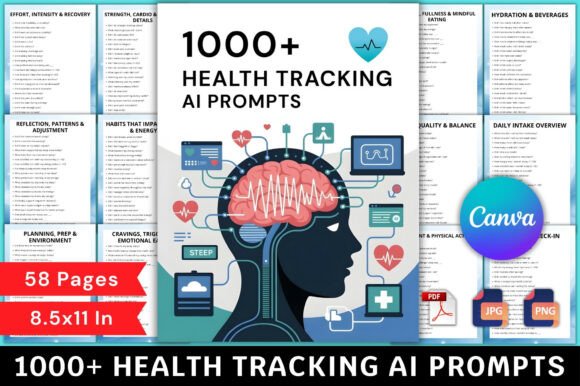
A Practical Guide to the 1000 Health Tracking AI Prompts Planner
Staying consistent with health tracking often feels more difficult than the habits themselves. Many people start with good intentions, logging meals or workouts for a few days, only to lose momentum when the process becomes repetitive or unclear. The 1000 Health Tracking AI Prompts planner attempts to solve this by combining structured daily prompts with AI compatibility, creating a system that supports reflection and accountability without requiring hours of manual journaling. This article offers an objective look at what the planner includes, how it works in practice, and who may find it genuinely useful.
What the Planner Offers and Why It Stands Out
At its core, this is a 58-page digital planner designed to guide users through daily health tracking across multiple dimensions. The 1000 Health Tracking AI Prompts are its defining feature: carefully written questions that cover mindset, nutrition, movement, sleep, emotional health, daily check-ins, and habit consistency. Rather than relying on generic journaling prompts, the questions are structured to work with AI tools, allowing users to paste responses into an assistant for deeper pattern recognition or personalized feedback.
The planner is delivered as a printable high-resolution PDF in 8.5 x 11 inch format, making it accessible whether you prefer digital note-taking apps or physical printouts. It includes sections for morning intentions, evening reflections, mood tracking, hydration logs, workout notes, and progress reviews. Each section contains prompts that are specific enough to be useful but open-ended enough to accommodate different lifestyles and goals.
Key Characteristics
- Comprehensive scope: Covers physical, mental, emotional, and habit-based tracking in one resource.
- AI-optimized prompts: Questions are formulated to work seamlessly with AI tools for deeper analysis.
- Printable and portable: The PDF format allows for flexible use across devices or paper.
- Structured yet flexible: Daily check-ins follow a consistent framework but leave room for personal entries.
- 58 pages of guided content: Enough material to support sustained use without becoming overwhelming.
Practical Value in Real-World Use
When testing resources like this, the main question is whether they help users actually follow through. The 1000 Health Tracking AI Prompts planner addresses the two most common reasons people stop tracking health: lack of variety and lack of feedback. By offering a large pool of prompts, it reduces the boredom of repeating the same questions every day. The AI integration layer adds a feedback loop that traditional paper planners cannot provide.
For example, a user who logs meals and mood daily can paste their week of entries into an AI assistant and receive observations about correlations between food choices and energy levels. This transforms the planner from a passive logging tool into a system that supports active learning. The prompts are written in a way that encourages honest reflection rather than checkbox-style answers, which improves the quality of data you collect about yourself.
Strengths Worth Noting
Variety and depth: With 1000 prompts spread across seven categories, the planner avoids the redundancy found in many habit trackers. Each prompt is distinct enough to encourage new thinking about familiar routines. The mindset and emotional health sections, in particular, include questions that prompt genuine self-inquiry rather than surface-level logging.
AI compatibility is intentional: The prompts are not just random questions. They are structured to produce responses that an AI tool can parse for trends, contradictions, or areas needing attention. This makes the planner more valuable for users already comfortable with AI assistants or those willing to experiment with them.
Print quality and layout: The PDF is clean and readable, with enough space for written responses. The 8.5 x 11 inch size works well in standard binders or clipboards, and the design does not waste space on decorative elements that reduce usability.
Quality, Usability, and Flexibility
The planner performs well in terms of build quality for a digital product. The PDF prints cleanly on most home or office printers, and the layout is consistent throughout. Each section has clear headings and sufficient room for notes. The prompts are written in plain, direct language without unnecessary jargon or motivational slogans, which makes them suitable for a wide range of readers.
Usability is strong for self-directed users. The planner does not require a specific app or platform; you can use it with any PDF reader, note-taking software like Notability or GoodNotes, or as a printed document. This flexibility is important for people who want to integrate tracking into existing workflows without adopting a new ecosystem.
However, the planner is less structured for users who prefer guided goal-setting or pre-defined routines. It provides prompts and space, but you must decide how to incorporate them into your day. This works well for independent individuals but may feel too open-ended for someone who needs more structure to stay consistent.
Flexibility Across Contexts
The 1000 Health Tracking AI Prompts planner can be used in several ways:
- Daily journaling: Pick one or two prompts from each category per day for a balanced check-in.
- Weekly deep dives: Focus on one category per week—such as sleep or nutrition—and work through its prompts in detail.
- AI-assisted review: Log responses digitally and periodically feed them to an AI tool for summary insights.
- Group or coaching use: Health coaches or small group facilitators can use the prompts to guide discussions or assign reflection tasks.
Who Benefits Most and In What Situations
This planner is best suited for adults aged 20–50 who have some experience with self-tracking but want more depth and variety. It is particularly valuable for professionals, freelancers, and entrepreneurs who manage demanding schedules and need an efficient way to monitor their health without complicated tools. People already using AI tools for productivity will find the prompt structure especially useful, as it integrates naturally with existing workflows.
It also works well for serious hobbyists interested in personal development, fitness, or nutrition who want a structured method for reflection. Educators and small business owners who teach or coach others can adapt the prompts for group use or client assignments.
Practical Examples
A marketing professional working long hours might use the mental health check-in prompts at the end of each day to identify stress patterns and adjust routines. A freelance writer could combine morning intention prompts with habit tracking to maintain consistency with exercise while managing variable work hours. A health coach could print the planner for clients as a structured supplement to coaching sessions.
These use cases work because the planner does not prescribe a specific routine. It provides the raw material—prompts, categories, and space—and lets the user decide what fits their life.
Possible Limitations to Consider
No resource is universally effective, and this planner has limitations worth noting. First, it is not a guided program. There are no instructions on how often to use each section, how to combine prompts, or how to interpret responses. Users must be comfortable creating their own system.
Second, the AI integration assumes familiarity with AI tools. If you are not using AI assistants, the prompts still work on their own, but you lose the analytical advantage that distinguishes this planner from standard journals.
Third, 58 pages may be too much for someone who only wants basic habit tracking. The breadth of content is a strength for sustained use, but it may feel excessive if you are looking for a simple daily checklist.
Professional Observations
From a practical standpoint, the 1000 Health Tracking AI Prompts planner fills a gap between generic journaling apps and specialized health tracking tools. It does not attempt to replace devices or apps that measure biometrics, but it complements them by capturing the subjective, qualitative side of health—how you feel, what you think, and why you make certain choices. This subjective data is often more actionable than steps or calories alone.
The prompt quality is noticeably better than most free resources. The questions avoid vague phrasing like “How are you feeling?” and instead ask specific, directional questions such as “What external factor most influenced your mood today?” or “Describe your energy level variation between morning and afternoon.” This specificity generates responses that are easier to analyze and act on.
Long-Term Value and Sustainability
A planner like this provides long-term value primarily through its reusability. Because it contains 1000 distinct prompts, you can go through the entire set without repetition, and then start again with a different focus or deeper reflection. The printable format also means you can use selected pages rather than the full document, customizing your experience over time.
The AI-optimized angle adds another dimension of longevity. As AI tools improve, the ability to process and interpret natural language entries will only become more powerful. Investing in a resource that captures high-quality, structured input now positions you to benefit from those advances later.
That said, the planner's value depends on consistent use. Like any habit tracking tool, it works when you work with it. The prompts are designed to reduce friction, but they cannot replace personal commitment.
Final Considerations for Potential Users
If you are looking for a health tracking resource that goes beyond surface-level logging and supports deeper self-awareness, the 1000 Health Tracking AI Prompts planner is worth examining. It is not a quick fix or a magic solution, but it is a well-constructed tool that respects your time and intelligence. The variety of prompts, the thoughtful structure, and the AI compatibility make it a practical choice for adults who want clarity and consistency without unnecessary complexity.
For those who prefer guided programs or very simple systems, it may feel like more than you need. But for independent individuals who value flexibility, depth, and the ability to adapt a tool to their own life, this planner offers a solid foundation for long-term health tracking.