1000 Quranic Thought Journaling Prompts: A Practical Guide to Deepening Quranic Reflection
Many Muslims seek a consistent way to engage with the Quran beyond recitation. The desire to reflect deeply, internalize lessons, and apply divine guidance to daily life is a natural part of spiritual growth. Yet without structure, this intention often fades into sporadic reading or a sense of guilt about not doing enough. 1000 Quranic Thought Journaling Prompts addresses that gap by providing a complete framework for turning Quranic reflection into a repeatable, sustainable practice.
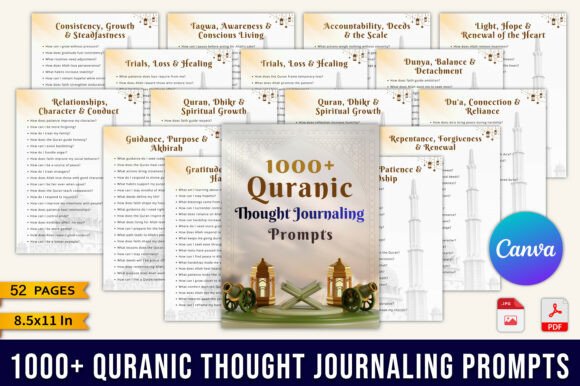
This is not simply a collection of questions. It is a spiritually guided planner that integrates self-accountability, emotional healing, and character building with the wisdom of the Quran. The prompts are organized into theme-based sections covering Allah’s Attributes, Gratitude, Patience, Tawakkul, Repentance, Purpose, and the Akhirah. Each prompt is crafted to spark deep thought and invite honest journaling. For anyone looking to move from passive reading to active engagement with the Quran, this tool provides the missing structure.
Where the Planner Fits in a Broader Process
Spiritual development, like any meaningful pursuit, benefits from a process. Reading the Quran is the input. Reflecting, journaling, and applying are the processing and output stages. 1000 Quranic Thought Journaling Prompts functions as the processing engine between the text of the Quran and your daily actions. It helps you move from “I read this verse” to “What does this mean for my life right now?”
Consider your existing routine. Perhaps you read a few pages after Fajr or listen to a tafsir podcast during a commute. These are valuable inputs, but they often lack a structured output mechanism. The prompts fill that role. They transform passive consumption into active reflection. By writing responses, you create a personal record of insights that can be revisited, compared, and built upon over time. This turns Quranic study from an occasional activity into an ongoing process of growth.
Before, During, and After: Using the Prompts in Your Workflow
One of the strengths of the planner is its flexibility across different phases of your day or week. You can use the prompts before a task to set intention, during a study session to deepen understanding, or after an event to process experiences through a Quranic lens.
Before a project or decision: If you are starting a new business, preparing for a presentation, or making a major life choice, select prompts from the Tawakkul or Purpose sections. Writing about trust in Allah’s plan or clarifying your intentions before you begin aligns your mindset and reduces anxiety. It takes ten to fifteen minutes and sets a focused tone for the work ahead.
During a learning activity: When studying a specific surah or topic, match the relevant theme-based section. For example, if you are exploring verses about patience in the Quran, use the Patience prompts to journal your understanding and personal struggles. This deepens retention and makes the learning personal rather than abstract.
After a challenging event or creative process: Reflection after the fact is where much of the growth happens. A difficult conversation, a creative block, or a setback can be processed using prompts from the Repentance or Self-Accountability sections. Writing through these experiences with Quranic guidance helps you extract lessons without spiraling into self-criticism.
Integration with Other Tools and Resources
The planner is designed to complement, not replace, other Quranic study tools. It works well alongside a tafsir book, a Quran app with translation, or a weekly study circle. You can use the prompts as pre-work before joining a group discussion, or as follow-up after listening to a lecture. The key is that the prompts provide a personal layer that group settings often miss: private, honest self-reflection.
If you use a digital planner or a bullet journal, the 8.5×11 inch PDF pages can be printed or imported into note-taking apps. The editable Canva link allows you to customize prompts if you want to adjust the wording slightly for your context. For educators and bloggers, the theme-based structure makes it easy to pull specific prompts for content creation, lesson planning, or community challenges.
For those who already maintain a gratitude journal or a daily log, the prompts can replace or supplement existing entries. Instead of writing generic gratitude points, you answer a prompt like “How does this verse call me to be more grateful today?” This adds depth and spiritual grounding to an existing habit.
Practical Implementation Tips
To integrate the planner smoothly into your routine, start with small commitments. Do not try to answer multiple prompts in one sitting especially if you are new to journaling. One prompt per day is sufficient to build momentum. Keep the journal visible: place it near your prayer area or in your work bag as a reminder.
For professionals and entrepreneurs: Use a prompt during your lunch break or right after Zuhr prayer. The structured format means you do not need extra mental energy to figure out what to write. You just respond to the question. This makes it ideal for busy schedules where unstructured reflection rarely happens.
For educators and content creators: the 52 different Canva templates allow you to create consistent branded content around specific themes. You can design a weekly prompt series for students or followers, pulling from the gratitude, patience, or purpose sections. The high-quality PDF files can also be printed and distributed in physical workshops or classes.
For hobbyists and creative individuals: Use prompts as a warm-up before painting, writing, or composing. The act of reflecting on a Quranic theme often unlocks creative insight and emotional clarity that feeds directly into your craft.
Organization and Consistency for Long-Term Use
Spiritual growth is not a sprint. The value of 1000 prompts becomes apparent after weeks and months of consistent use. The theme-based organization helps you track which areas you have covered and which need more attention. You might notice that you naturally avoid topics like repentance or self-accountability, and that awareness itself becomes a prompt for growth.
For quality control of your spiritual practice, periodic review of past journal entries is powerful. Every few weeks, read back through your responses. Patterns emerge areas where you have grown, recurring struggles, and shifts in perspective. This meta-reflection is itself a form of self-accountability and deepens the impact of the tool.
The planner also supports seasonal use. During Ramadan, you might work through the Patience and Gratitude sections intensively. During a period of uncertainty, the Tawakkul and Akhirah prompts provide grounding. The flexible structure means you can adapt without losing continuity.
Useful Observations for Smooth Integration
One common pitfall is treating the prompts as a test with right or wrong answers. The purpose is exploration, not evaluation. Write freely, even if the response feels incomplete. Over time, your writing will become more natural and insightful.
Another observation: pairing the planner with a consistent reading schedule enhances both activities. If you read one page of Quran daily, choose a prompt from a relevant theme before or after reading. This creates a closed loop where input and reflection reinforce each other.
For those who prefer digital workflows, the PDF files can be uploaded to cloud storage and accessed across devices. The editable Canva link is especially useful for teams or families who want to share prompts and compare reflections without printing copies.
Efficiency and Usability in Daily Life
The planner’s efficiency comes from its structure. You do not waste time deciding what to reflect on. The prompts are curated, tested, and organized. This reduces friction and makes journaling a five-minute habit rather than a thirty-minute struggle. For adults juggling work, family, and spiritual goals, this efficiency is critical for consistency.
Usability extends to the physical format. The 8.5×11 inch page size provides enough space for substantial writing without feeling cramped. The ready-to-upload PDF files are print-ready, so you can produce a physical journal in minutes. The 52 different Canva templates also allow for variety if you are creating a personal notebook or a product for others.
Building a Personal System Around the Prompts
Over time, you may develop your own system around the planner. For example, you could dedicate one prompt per week and use the daily pages to expand on that theme. Or you could cycle through the sections on a monthly basis, spending one month on gratitude and the next on patience. The key is to treat the planner as a flexible resource rather than a rigid syllabus.
For small business owners and publishers, the planner can also serve as a product template. The editable Canva link and high-quality PDF files make it straightforward to customize and resell or gift to customers. The theme-based sections appeal to a wide audience, and the 1000 prompts provide substantial value in a single package.
Final Thoughts on Making the Planner Work for You
1000 Quranic Thought Journaling Prompts is a tool that rewards consistent use. Its real power lies not in any single prompt but in the cumulative effect of daily reflection. By integrating it into your existing routines, pairing it with other resources, and adapting the pace to your life, you build a sustainable practice that strengthens your connection with the Quran and with Allah.
Start with one prompt tomorrow. See where the reflection takes you. Over weeks and months, the small habit compounds into genuine spiritual growth. That is the measure of a well-designed tool: it makes the right thing easy to do, day after day.