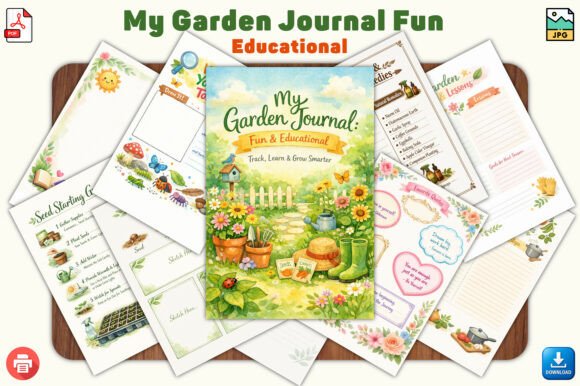
My Garden Journal Fun Educational: A Practical Resource for Gardeners of All Ages
Gardening is one of those rare activities that blends science, art, and personal satisfaction into a single, rewarding experience. Whether you are tending a small balcony container garden or managing a sprawling backyard plot, the act of growing plants offers lessons in patience, ecology, and nurture. However, even the most enthusiastic gardener can benefit from a structured approach to tracking progress, documenting observations, and planning ahead. This is where a dedicated journal becomes more than a notebook—it becomes a tool for deeper understanding and consistent improvement. My Garden Journal Fun Educational is designed exactly for this purpose, providing a framework that transforms casual gardening into a richer, more intentional practice.
Understanding the Role of a Garden Journal in Modern Gardening
A garden journal serves multiple functions that extend far beyond simple record-keeping. At its core, it is a repository for data that helps gardeners make informed decisions. Over time, tracking factors like planting dates, weather conditions, and pest activity reveals patterns that can improve yield and plant health. For example, noting that a particular vegetable thrives when planted after the last frost date—and fails when planted even a week earlier—provides actionable insight for future seasons. My Garden Journal Fun Educational formalizes this process by offering dedicated sections for each critical aspect of gardening, ensuring that no observation goes unrecorded.
Furthermore, a journal encourages mindfulness. When you pause to document the appearance of a new sprout or the arrival of the first pollinator, you engage more deeply with the garden. This reflective practice is especially valuable for children, who often learn best through hands-on, sensory experiences. By combining structured tracking with creative prompts, the journal bridges the gap between empirical observation and personal expression.
Key Features and Their Real-World Applications
The 20-page printable format of My Garden Journal Fun Educational is organized around the most common needs of gardeners. Each page serves a specific purpose, from diagnosing soil health to celebrating a successful harvest. Below is a closer look at how these features function in practice.
Soil Health Guide and Companion Planting Chart
Healthy soil is the foundation of any successful garden. The Soil Health Guide helps users identify their soil type—whether sandy, clay, or loamy—and provides simple DIY tests to measure pH and nutrient levels. Understanding soil composition allows gardeners to amend it appropriately, choosing the right fertilizers or organic matter. The Companion Planting Chart, meanwhile, offers a visual reference for which plants support each other and which should be kept apart. For instance, planting basil near tomatoes can enhance flavor and deter pests, while fennel tends to inhibit the growth of many vegetables. These insights reduce the need for chemical interventions and support a more natural ecosystem.
Planting and Germination Trackers
From seed to harvest, every plant follows a unique timeline. The Planting Germination Trackers allow users to record the date seeds are sown, the day they first emerge, and subsequent growth milestones. This data is invaluable for planning succession plantings and for understanding how different varieties perform under local conditions. A gardener in the Pacific Northwest, for example, might note that certain bean varieties require two extra weeks to germinate compared to the seed packet’s recommendation—a discovery that can save time and resources in future seasons.
Pest Problem Log and Watering Weather Log
Pests and weather are two of the most unpredictable variables in gardening. The Pest Problem Log provides a space to document what pests appear, the damage they cause, and any control methods attempted. Over several seasons, this log becomes a personalized guide to managing local pest populations. The Watering Weather Log complements this by tracking rainfall, temperature, and humidity. By correlating these records with plant health, gardeners can fine-tune their irrigation schedules. For example, a week of heavy rain might prompt a reduction in watering, while a dry spell signals the need for deeper, less frequent soaking.
Seasonal Planting Calendar and Harvest Log
The Seasonal Planting Calendar helps users plan their garden year-round, accounting for regional frost dates and crop rotation needs. This forward-looking tool ensures that gardeners are never caught off guard by a missed planting window. The Harvest Log, paired with Recipe Ideas, celebrates the fruits of labor while also providing a space to note which varieties produced the best flavor or yield. This information guides seed selection for the following year, creating a cycle of continuous improvement.
Pollinator Wildlife Tracker and Kids’ Discovery Page
Beyond the vegetables and flowers, a garden is a habitat. The Pollinator Wildlife Tracker encourages users to record visits from bees, butterflies, birds, and other beneficial creatures. This fosters an appreciation for biodiversity and can highlight the impact of planting native species. The Kids’ Discovery Page includes quotes and fun prompts that spark curiosity—such as “Draw the smallest bug you see today” or “Write about how the garden smells after rain.” These pages transform the journal into a shared family activity, blending education with entertainment.
How Different User Groups Benefit from This Resource
The versatility of My Garden Journal Fun Educational makes it suitable for a wide audience. Here are some examples of how specific groups can integrate it into their gardening routines.
Families with Young Children
For families, the journal becomes a bonding tool that encourages outdoor exploration. Parents and children can work together to fill in the Kids’ Discovery Page or track the growth of a sunflower from seed to flower. The journal’s combination of structured data and open-ended creativity helps children develop observation skills, patience, and a sense of responsibility. It also provides a tangible record of the family’s gardening journey, which can be revisited in future years.
Educators and Homeschoolers
Teachers and homeschooling parents will find the journal aligns closely with science and environmental education standards. The Soil Health Guide and Companion Planting Chart introduce concepts in chemistry and ecology, while the Planting Germination Trackers offer a real-world application of the scientific method. Students can formulate hypotheses about germination rates or pest deterrence and then test them using their own garden plots. The journal’s printable format is especially convenient for classroom settings, where multiple copies can be distributed without the need for individual purchases.
Hobby Gardeners and Community Gardeners
For individuals who garden as a hobby, the journal provides a way to systematize what might otherwise be a casual activity. A community gardener managing a shared plot can use the Pest Problem Log to coordinate pest control with other members, ensuring that efforts are consistent and effective. The Watering Weather Log helps avoid over- or under-watering, which is a common issue in community settings where different people tend to the same plants. Over time, the journal becomes a reference that improves efficiency and reduces waste.
Business Owners and Landscape Professionals
Small-scale farmers, nursery owners, and landscape designers can also benefit from the journal’s structure. For a market gardener, the Harvest Log combined with crop rotation notes can optimize yield per square foot. Landscape professionals might use the Seasonal Planting Calendar to plan maintenance schedules for clients. While the journal is designed with home gardeners in mind, its principles apply to any context where plants are grown intentionally.
Design and Format Considerations for Effective Use
The physical design of a journal greatly influences how it is used. My Garden Journal Fun Educational is provided as JPG and PDF files in a standard 6×9 inch size, which fits comfortably in most bags and can be printed at home or at a print shop. The 21-page format encourages frequent use without becoming overwhelming. Because the files are printable, users can duplicate specific pages—such as the Planting Germination Tracker or the Pest Problem Log—as needed for multiple beds or seasons.
The layout balances text space with room for sketches and notes. This is particularly important for visual learners and for children who may prefer drawing to writing. The inclusion of quotes and prompts on the Kids’ Discovery Page adds an element of surprise and inspiration. By keeping the design simple yet functional, the journal avoids the clutter that can make other planning tools feel like a chore.
Integrating Gardening Knowledge with Hands-On Practice
One of the greatest strengths of a structured garden journal is that it encourages the application of theoretical knowledge. Many people read about companion planting or soil testing but never actually implement these practices. The journal’s framework makes it easy to start small—for example, by trying one companion pairing and documenting the results. As confidence grows, users can expand their efforts to include more advanced techniques like crop rotation or integrated pest management.
Consider the example of a gardener who has struggled with aphids on their kale plants. Using the Pest Problem Log, they note that the aphids appear in late spring each year. They then research natural predators and decide to plant dill and fennel nearby to attract ladybugs. The following season, they record a significant reduction in aphid damage. Without the journal, this pattern might have gone unnoticed, and the solution might never have been attempted.
Observations on Long-Term Use and Adaptation
As gardeners continue using My Garden Journal Fun Educational over multiple seasons, the accumulated data becomes a personalized reference manual. The journal adapts to the user’s unique climate, soil, and preferences. What works for a gardener in arid Arizona will differ from the experience of one in humid Georgia, and the journal reflects those differences through the user’s own entries. This localized knowledge is far more valuable than generic advice found in books or online articles.
Another observation is that the journal encourages restraint. By tracking which varieties and techniques succeed, gardeners naturally become more selective about trying new things. Instead of buying every interesting seed packet, they focus on proven performers and experiment with only one or two new additions each year. This reduces waste and increases overall satisfaction with the garden’s results.
Practical Tips for Getting the Most Out of the Journal
To maximize the benefits of My Garden Journal Fun Educational, consider a few practical strategies:
- Print multiple copies of high-use pages. The Planting Germination Tracker and Harvest Log are likely to be used for many different plants, so having extra copies on hand simplifies the process.
- Make it a habit. Set aside five minutes every few days to update the journal. This consistency prevents gaps in data and makes the journal a regular part of the gardening routine.
- Involve the whole family. Assign different pages to different family members. For example, a child might be responsible for the Pollinator Wildlife Tracker, while an adult handles the Watering Weather Log.
- Review entries at the end of each season. Take time to read through the journal and note successes and challenges. This overview can inform next season’s plan and help refine goals.
The Broader Impact of Structured Gardening
On a larger scale, the practice of keeping a garden journal contributes to a more thoughtful and sustainable relationship with the environment. When people document their interactions with soil, plants, and wildlife, they become more aware of ecological connections. This awareness often leads to greater efforts in conservation, such as reducing pesticide use or planting native species. My Garden Journal Fun Educational supports this shift by providing tools that are both educational and practical, making it easier for individuals and families to contribute to environmental stewardship in their own small corner of the world.
Moreover, the journal serves as a record of personal growth. Looking back at earlier entries, gardeners can see how their skills have developed over time. A note about a failed tomato crop from three years ago becomes a lesson learned, and a sketch of the first butterfly observed in the garden becomes a cherished memory. In this sense, the journal is as much about preserving experiences as it is about improving outcomes.
Whether you are a seasoned gardener looking to systematize your approach or a newcomer eager to learn by doing, a tool like My Garden Journal Fun Educational can transform the way you interact with your garden. By combining data tracking with creative expression, it addresses both the analytical and emotional aspects of gardening. The result is a more fulfilling and productive experience that grows richer with each passing season.