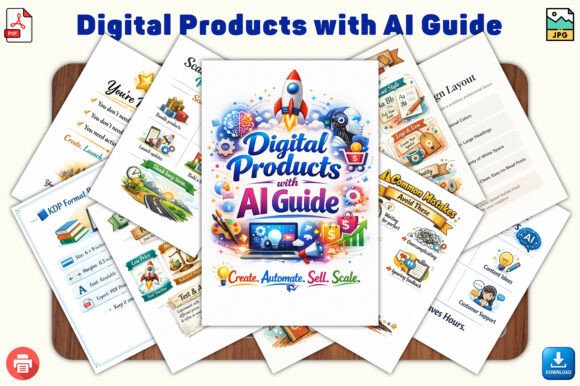
Digital Products with AI Guide: A Practical Roadmap to Modern Digital Entrepreneurship
Over the past few years, the landscape of digital entrepreneurship has shifted dramatically. What once required days of manual design, endless research, and technical know-how can now be accomplished in hours—thanks to artificial intelligence. But with so many tools and strategies floating around, knowing where to start can feel overwhelming. That's exactly where the Digital Products with AI Guide steps in. This 30-page resource isn't just another ebook; it's a structured, action-oriented system designed to help you create, automate, sell, and scale digital products using AI—regardless of your technical background.
Whether you're a complete beginner exploring digital products for the first time, a creator looking to streamline your workflow, or an entrepreneur building passive income streams, this guide offers a clear path forward. Let's take a closer look at what makes it valuable, how it works in practice, and who stands to benefit most from it.
What Is the Digital Products with AI Guide?
At its core, the Digital Products with AI Guide is a beginner-friendly, step-by-step manual that walks you through the entire process of building profitable digital products using AI tools. It's designed for clarity and action, with minimal design, clean layouts, and a focus on results. The guide covers everything from niche selection and idea generation to product creation, marketing, and automation.
Unlike many resources that are heavy on theory and light on execution, this guide emphasizes practical steps. Each page is structured to help you move from one stage to the next without getting bogged down in unnecessary complexity. The 6×9 inch format makes it easy to read on any device, and the included JPG and PDF files ensure compatibility across platforms.
Who Is This Guide For?
The Digital Products with AI Guide is intentionally broad in its appeal, yet specific in its application. Here are the primary groups that will find it most useful:
- Beginners who have little to no experience with digital products but want to start building income streams without a steep learning curve.
- Creators who want to accelerate their content and product creation workflows using AI, freeing up time for strategy and growth.
- Entrepreneurs focused on building passive income through digital assets such as printables, templates, and guides.
- Freelancers and online sellers looking to diversify their offerings and scale beyond one-on-one services.
- Students and learners exploring AI applications in a practical, monetizable context.
- Anyone with marketable skills who wants to package them into a digital product with minimal friction.
The guide doesn't assume prior experience with AI or design tools. It's built for people who want results without needing to become technical experts first.
What's Inside: A Breakdown of the Guide's Core Components
Let's walk through the major sections of the Digital Products with AI Guide and what each delivers in practical terms.
Choosing a Profitable Niche
One of the most common pitfalls in digital product creation is picking a niche that's either too broad or too saturated. This guide provides a framework for evaluating niche profitability using AI-powered research tools. Instead of guessing what might sell, you'll learn how to identify demand, assess competition, and select a niche where you can offer genuine value.
AI Tools to Speed Up Creation
The guide introduces a curated set of AI tools that handle heavy lifting tasks like content generation, image creation, formatting, and even basic design. Rather than listing every tool available, it focuses on those that integrate well with the product creation workflow. This keeps the learning curve gentle and the application immediate.
Idea Generation Frameworks
Blank page syndrome can stall even the most motivated creator. The guide includes structured frameworks for generating product ideas using AI prompts and market signals. You'll learn how to turn common questions, problems, or interests into digital product concepts that actually resonate with buyers.
Product Structure Templates
Knowing what to include in your product, and in what order, can save hours of decision-making. The guide provides templates for structuring digital products such as workbooks, planners, and mini-courses. These templates are designed to be adapted to your niche, not followed rigidly.
Canva Design Guidance
Visual design is often the biggest barrier for non-designers. The guide offers clear, non-technical guidance on using Canva to create professional-looking product pages, covers, and interiors. It emphasizes simplicity and consistency rather than flashy graphics.
KDP Formatting Basics
If you plan to publish on Amazon KDP, formatting can be a headache. This section covers the essential requirements for formatting a 6×9 inch book, preparing files for upload, and avoiding common rejection reasons. It's not a deep dive into typesetting, but it's enough to get your first product live.
Pricing and Packaging Strategies
Pricing digital products can feel arbitrary without a framework. The guide discusses how to evaluate value, test price points, and bundle products for higher perceived value. It also touches on the psychology of pricing, such as anchoring and tiered offers.
Launch and Marketing Plan
Creating a great product is only half the battle. This section outlines a launch sequence that includes pre-launch buzz, launch day tactics, and post-launch follow-up. It also covers basic marketing channels like email lists, social media, and content marketing—with a focus on automation where possible.
Automation with AI
Automation is where the guide's AI focus really shines. You'll learn how to set up automated workflows for customer delivery, email sequences, social media posting, and even product updates. The goal is to reduce hands-on time while maintaining quality and consistency.
Growth Checklist Worksheets
Every section concludes with actionable worksheets that serve as checklists. These aren't just for reading; they're for doing. By working through them, you build your product step by step, rather than reading passively and hoping to remember later.
Real-World Scenarios: How the Guide Applies in Practice
The true test of any resource is whether it works in real-world conditions. Here are a few scenarios where the Digital Products with AI Guide proves especially useful.
Scenario 1: The Freelancer Who Wants Passive Income
Imagine a freelance graphic designer who is trading time for money. They have skills but can't scale beyond their available hours. Using the guide, they identify a niche—social media templates for small businesses—and use AI tools to generate and format dozens of designs quickly. Within weeks, they have a digital product listed on Gumroad that generates income while they sleep.
Scenario 2: The Busy Parent Starting from Scratch
A parent with limited time and no technical background wants to create a simple printable meal planner. The guide helps them validate the idea, structure the product, design it in Canva, and list it on Etsy. The automation section shows them how to set up instant delivery so they don't have to manually fulfill orders.
Scenario 3: The Content Creator Building a Product Line
A YouTuber with a modest audience wants to launch a digital product to diversify revenue. Using the guide's marketing and launch plan, they create a companion workbook for one of their video series. The AI tools help them generate content and design the layout in hours instead of days.
Strengths and Considerations
No resource is perfect, and understanding the strengths and limitations of the Digital Products with AI Guide will help you decide if it's the right fit for your situation.
Strengths
- Beginner-friendly language: No jargon overload. Concepts are explained in plain terms.
- Action-oriented structure: Each section builds on the previous one, so you're not left wondering what to do next.
- AI integration: The guide doesn't just mention AI; it shows you how to use it meaningfully in each stage.
- Clean, minimal design: The visual layout supports comprehension rather than distracting from it.
- Practical templates and worksheets: These are reusable and adaptable beyond the initial project.
Considerations and Limitations
- Not a deep technical manual: If you're looking for advanced AI programming or complex marketing automation, this guide stays at the practical, accessible level.
- Focus on digital products only: It doesn't cover physical products or services, so it's best for those specifically interested in digital assets.
- Requires consistent effort: The guide provides the roadmap, but you still need to put in the time to implement each step.
- AI tools evolve quickly: Some tool recommendations may shift as new options emerge, but the frameworks remain relevant.
How to Evaluate If This Guide Is Right for You
Before committing to any resource, it's wise to ask a few questions about your own situation. Here are some criteria to help you decide if the Digital Products with AI Guide aligns with your goals.
- Do you want to create digital products but don't know where to start? This guide assumes you have zero prior experience and walks you through each phase.
- Are you looking for a structured system rather than scattered tips? The guide's sequential chapters and worksheets provide a cohesive process.
- Do you want to leverage AI without becoming an AI expert? The guide treats AI as a tool, not a subject of study. You use it, not master it.
- Are you willing to spend focused time over several days or weeks? This is not a one-hour read; it's a working guide that requires implementation.
- Do you prefer clean, minimal instruction over flashy design? The guide's aesthetic reflects its philosophy: clarity over complexity.
If you answered yes to most of these, you're likely in the right audience. If you need a highly technical resource or a purely theoretical overview, you might want something more specialized.
Final Thoughts: A Practical Companion for Modern Digital Creators
The Digital Products with AI Guide fills a specific gap in the market. It's not a dense textbook, not a hype-filled launch funnel, and not a collection of random tips. It's a structured, beginner-friendly system that respects your time and intelligence. It acknowledges that you don't need to be a designer, coder, or marketing guru to create digital products that sell—you just need a reliable process and the right tools.
The clean design, the focus on action, and the integration of AI as a practical accelerator make it stand out among similar resources. Whether you're testing the waters of digital entrepreneurship or looking to systematize your existing workflow, this guide offers a path that's both achievable and scalable.
If you're ready to move from idea to income without the overwhelm, the Digital Products with AI Guide provides the blueprint. The rest is up to you.