1000 AI Brain Training Prompt Book: A Structured Approach to Sharper Thinking
We are living through an unprecedented shift in how we think, work, and create. Information flows faster than ever, and the pressure to stay mentally agile, make sound decisions, and generate original ideas has never been higher. Many of us turn to AI for quick answers, but few realize its deeper potential as a genuine thinking partner. The 1000 AI Brain Training Prompt Book addresses this gap head-on. It is not just another collection of questions—it is a structured mental workout designed to strengthen reasoning, boost creativity, sharpen memory, and optimize performance across every area of your professional and personal life.
By weaving together 1000 carefully crafted prompts that span critical thinking, problem-solving, innovation, emotional intelligence, productivity, and advanced decision-making, this book turns an AI chatbot into a focused coach. Whether you are a marketer wrestling with strategy, a freelancer balancing multiple projects, or a creator searching for your next breakthrough, the 🧠 1000 AI Brain Training Prompt Planner offers a repeatable, actionable system for thinking clearer, learning faster, and executing smarter.
What the 1000 AI Brain Training Prompt Book Actually Is
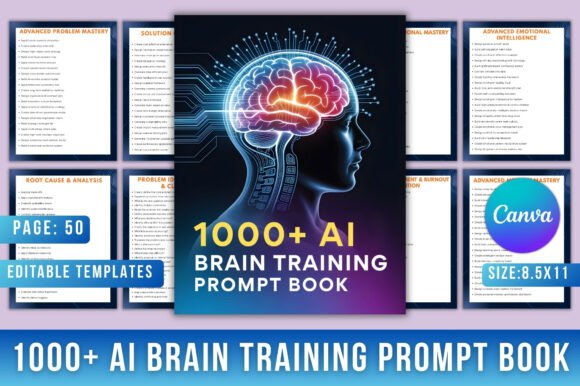
At its core, this resource is a printable or digital planner that contains 50 pages of prompt-driven exercises, all organized around nine key cognitive domains. The prompts are not random; they follow proven frameworks used in psychology, design thinking, and executive coaching. Each prompt is designed to be used in combination with an AI assistant—like ChatGPT, Claude, or others—where you answer, reflect, and then let the AI challenge, expand, or refine your thinking.
The planner includes an editable Canva link, a high-quality ready-to-upload PDF, and a page size of 8.5 x 11 inches with no bleed and 300 DPI. But the true value lies in the content: Critical Thinking Frameworks, Perspective Debate Training, Problem Deconstruction Tools, Creative Idea Generation, Memory Recall Systems, Focus Productivity Planning, Emotional Intelligence Development, Advanced Decision Execution Models, and Step-by-Step Learning Reinforcement. This is a comprehensive system, not a casual list of icebreakers.
Why Structured Thinking Has Become Essential
We are constantly interrupted by notifications, flooded with opinions, and pressured to multitask. The result is fragmented attention and shallow reasoning. Traditional productivity planners help with tasks but rarely train the underlying mental muscle. At the same time, AI has become a default tool for generating content and answers, yet most people use it passively—typing a query and accepting the output. The 1000 AI Brain Training Prompt Book flips this relationship. It insists on active engagement: you must first think, then compare, then refine.
This approach mirrors what cognitive science tells us about deep learning. Spaced repetition, perspective shifting, and deliberate practice are proven to improve memory and problem-solving. By embedding those principles into 1000 prompts, the planner makes mental training as routine as your morning coffee. For professionals in fields like marketing, consulting, education, and entrepreneurship, where original thinking is the currency of success, this is a game-changer.
From Passive AI User to Active Mental Athlete
Most people interact with AI by asking for help—"Write a blog outline," "Summarize this report," "Give me ideas for a campaign." The AI does the heavy lifting, and the human becomes a reviewer. Over time, this can actually weaken our own cognitive muscles because we outsource the hard parts. The 1000 AI Brain Training Prompt Planner rebalances the equation. The prompts force you to generate your own initial thoughts before the AI provides feedback. For example, a Perspective Debate Training prompt might ask you to argue a position you disagree with, then have the AI push back with counterarguments you hadn't considered. The result is deeper understanding and cognitive flexibility.
This shift is part of a larger trend in how people are using AI tools—moving away from pure automation toward augmented intelligence. Creators are using AI to brainstorm but then critically evaluate. Business owners are using AI to simulate customer responses and test assumptions. The book systematizes this practice, making it accessible to anyone regardless of their starting skill level.
How the Key Features Work in Real Life
Let's look at a few specific features and their practical applications. The Problem Deconstruction Tools section, for instance, contains prompts that break complex challenges into core components. Imagine you are a product manager facing declining user engagement. A prompt might guide you to first identify the problem's history, then map its stakeholders, then list all potential causes—each step discussed with the AI. Instead of jumping to a solution, you build a structured analysis that often reveals hidden assumptions.
The Creative Idea Generation prompts are not "give me 10 ideas." They use constraints and random connections to push you beyond your usual patterns. One prompt might ask you to combine your current project with an unrelated field (e.g., "How would a marine biologist approach your marketing problem?"). The AI can then simulate that perspective, offering insights you would never generate alone.
For those focused on productivity, the Focus Productivity Planning section moves beyond to-do lists. It uses time-blocking, energy mapping, and reflection cycles. A prompt may ask you to evaluate your last week's deep work hours and then plan an ideal schedule with the AI's help, adjusting for your actual energy patterns. This transforms productivity from a mechanical grind into a strategic alignment of effort and attention.
Practical Implications for Professionals, Creators, and Entrepreneurs
Consider a marketer who needs to understand a skeptical audience. The Perspective Debate Training prompts can be used to role-play as the customer, the competitor, and even the regulator. By walking through those debates with the AI, the marketer gains empathy and identifies blind spots in their campaign strategy. Similarly, a freelance writer might use the Memory Recall Systems prompts to reinforce key research facts, making their writing more accurate and authoritative over time.
Entrepreneurs face constant decision fatigue. The Advanced Decision Execution Models section provides structured frameworks like decision trees, pre-mortems, and opportunity cost analysis. A prompt might guide you through a "pre-mortem" before a product launch: imagine the launch failed six months from now; what went wrong? The AI helps you explore those failure scenarios, enabling you to build mitigations early. This is far more effective than relying on intuition alone.
Even educators and team leaders can use the planner as a professional development tool. By running a weekly "Brain Training" session with their team using selected prompts, they foster a culture of continuous improvement and intellectual curiosity. The editable Canva format makes it easy to customize prompts for specific industries or roles.
How to Get the Most Out of the Planner
The 1000 AI Brain Training Prompt Book is designed for consistency, not intensity. A realistic approach is to select one prompt category per week and complete two to three prompts each day. For example, start with Critical Thinking Frameworks for week one, then move to Creative Idea Generation for week two. Over the course of several months, you cycle through all nine domains, reinforcing what you've learned through repetition and variety.
Use the high-quality PDF to print the planner and keep it on your desk, or use the editable Canva link to work digitally. The key is to write your responses before engaging the AI, then treat the AI's response as a second opinion, not the final answer. Many users find it helpful to keep a separate journal for insights that emerge during these sessions. Over time, you will notice sharper problem-solving, faster recall, and more original ideas becoming habitual.
The Evolution of Personal Development Tools
We have seen personal development evolve from self-help books to online courses, from meditation apps to productivity systems. The next frontier is AI-augmented cognitive training, and the 1000 AI Brain Training Prompt Planner represents a significant step in that direction. It bridges the gap between raw human effort and machine assistance, creating a synergy that amplifies our natural abilities without replacing them. Unlike passive content consumption, this planner demands active participation, making each session a genuine workout.
As remote work and digital collaboration become permanent fixtures, the ability to think clearly and creatively without constant external input is a superpower. The planner also fits into the growing interest in neuroplasticity and lifelong learning. People are more aware than ever that their cognitive skills need regular exercise, just like their bodies. This resource offers a structured, evidence-informed way to do that, using tools most of us already have at our fingertips.
The 1000 AI Brain Training Prompt Book is more than a product—it is a methodology. It recognizes that the best AI is not the one that answers for you, but the one that questions you. For anyone serious about upgrading their thinking, optimizing their performance, and staying ahead in a rapidly changing world, this planner provides a clear and rewarding path forward.