AI Art Prompt Secrets
Creating AI art often feels like a guessing game. You type a few words, hit generate, and hope for the best. Sometimes the results surprise you, but more often they fall flat. The image doesn't match what you imagined. The composition feels off. The style looks generic. That gap between intention and output is where most people get stuck. AI Art Prompt Secrets addresses that gap directly by showing you how to structure prompts with intention, not guesswork.
The frustration many creators experience isn't because AI tools are limited. Modern image generation models are incredibly capable. The real bottleneck is how you communicate with them. Without a clear prompt structure, even the most advanced AI returns inconsistent, low-quality, or random results. You might not know which keywords matter, how to describe a mood, or what terms influence lighting and composition. This guide removes that uncertainty by breaking the prompt-writing process into a repeatable system.
Why prompt structure matters more than you think
Consider what happens when you describe a scene to another person. You choose words carefully, adjust details based on their understanding, and clarify when something isn't clear. AI works similarly, but it has no intuition. It interprets every word literally. A vague prompt like "a forest at sunset" leaves too much room for interpretation. The AI might generate a cartoon forest, a photorealistic one, or something surreal. None of those are wrong, but they may not be what you wanted.
AI Art Prompt Secrets teaches you a core formula that eliminates that ambiguity. Instead of hoping the AI guesses correctly, you learn to specify style, mood, lighting, perspective, and composition in a way the model understands. The result is artwork that aligns with your vision, not a random interpretation of it.
The cost of trial and error
Many creators try to brute-force their way to good results. They generate dozens, sometimes hundreds, of variations, changing one word at a time, hoping to stumble on something usable. That approach wastes time, consumes computing resources, and drains creative energy. By learning a structured prompt methodology, you reduce that trial-and-error significantly. You know what each word contributes to the final image. You can predict how changes affect the output. That predictability is what turns AI art from a hobby into a reliable creative tool.
What the prompt formula actually looks like in practice
The guide introduces a modular approach to prompt construction rather than a rigid template. You learn to separate your prompt into functional layers. One layer handles the subject and its attributes. Another addresses artistic style and medium. A third manages lighting, color palette, and atmosphere. A fourth controls camera perspective and framing. Each layer adds precision without making the prompt feel complicated or overwhelming.
For example, instead of writing "a woman reading a book in a library," you learn to write something like "a young woman reading a worn leather book in a dimly lit Gothic library, oil painting style, warm candlelight, shallow depth of field, portrait composition." Every additional detail serves a purpose. The style keyword "oil painting" tells the AI what medium to emulate. "Dimly lit" and "warm candlelight" set the mood. "Shallow depth of field" and "portrait composition" control the framing. The result is specific, intentional, and reproducible.
Negative prompts and what to exclude
One of the most overlooked aspects of prompt writing is knowing what to tell the AI not to include. Negative prompts are instructions that remove unwanted elements from generated images. AI Art Prompt Secrets covers this in practical detail. You learn how to exclude common artifacts, avoid unwanted styles, and prevent the AI from adding elements that distract from your subject. This alone can dramatically improve image quality, especially when working with complex scenes or specific artistic constraints.
Practical benefits for real-world use cases
The value of structured prompt writing extends beyond personal creative projects. For digital entrepreneurs, consistent, high-quality AI art supports branding, social media content, and product visuals. Instead of hiring a designer for every social post or marketing image, you can generate professional-looking artwork on demand. The guide shows you how to adapt prompts for covers, banners, thumbnails, and presentation graphics, all while maintaining a cohesive visual identity.
Bloggers and publishers benefit from the ability to generate custom illustrations that match their content exactly. Rather than searching stock photo libraries for something that almost fits, you produce images that align with your article's tone and subject. This strengthens your visual storytelling and makes your content more engaging without requiring artistic skills or expensive software.
Freelancers and creative professionals
If you offer design services, content creation, or branding consultations, mastering AI art prompts expands what you can deliver. You prototype visual concepts quickly, present mood boards with precision, and iterate on client feedback without starting from scratch each time. The prompt structure taught in AI Art Prompt Secrets gives you a repeatable process that saves time and improves client satisfaction. Instead of spending hours tweaking settings or regenerating failed attempts, you spend that time refining ideas and producing finished work.
Who gets the most out of this approach
This guide is designed for beginners, but its value extends to anyone who wants more control over AI-generated imagery. If you have never written a prompt before, the fundamentals give you a clear starting point. If you have already experimented with AI art but feel stuck, the structured formulas help you diagnose what isn't working and fix it. Creators, designers, marketers, educators, hobbyists, and small business owners all benefit from a systematic approach because the underlying principles apply regardless of the AI tool you use.
That said, no single guide covers every edge case. Different AI models interpret prompts slightly differently. Some respond better to certain keywords than others. The principles in AI Art Prompt Secrets give you a strong foundation, but you may need to adapt them based on the specific platform or model you are using. Think of it as learning the grammar of a language. Once you understand the grammar, you can speak in different dialects and still be understood.
Limitations and fit considerations
A structured prompt approach works best when you have a clear vision of what you want to create. If you prefer exploring random outputs for inspiration, a more improvisational style might suit you better. Similarly, if you are working with highly specialized or niche visual concepts, you may need to combine these prompt techniques with custom training or additional reference images. The guide gives you the essential toolkit, but advanced use cases sometimes require deeper customization.
For most everyday applications, however, the formula-based method delivers reliable, high-quality results. It solves the core problem that frustrates most users: the inability to translate imagination into AI-generated imagery with consistency and precision.
What you actually learn inside the guide
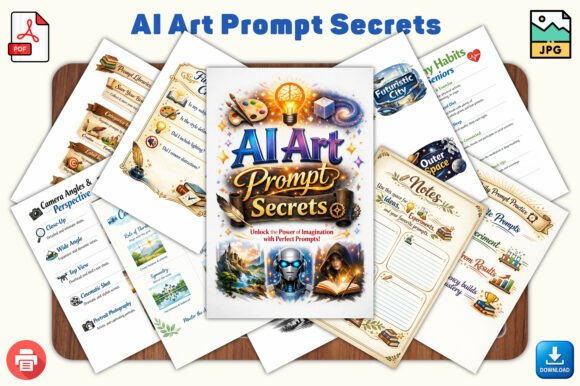
The content covers the fundamentals of AI art prompt construction in a logical sequence. You start with the basic anatomy of a prompt and understand what each component contributes. From there, you explore specific prompt structure formulas designed for different outcomes. One formula works well for realistic portraits. Another produces stylized illustrations. A third handles atmospheric landscapes. Each formula is explained with examples so you see exactly how the words shape the final image.
Beyond structure, the guide dives into artistic elements that professionals use to elevate their work. You learn how to describe styles, moods, lighting conditions, and perspectives using language that AI models understand. The section on negative prompts helps you avoid common pitfalls that degrade image quality. By the end, you have a complete system for writing prompts that produce consistent, professional-looking artwork across a variety of subjects and genres.
Saving time by thinking differently about prompts
The biggest shift this guide encourages is moving from reactive to proactive prompting. Instead of generating an image, looking at it, and figuring out what to change, you learn to anticipate how each word affects the output. That foresight cuts down on wasted iterations and accelerates your creative workflow. You spend less time correcting mistakes and more time exploring variations that actually move your project forward.
For anyone who uses AI art regularly, that efficiency gain is the difference between treating image generation as a chore and treating it as a creative advantage. When you can produce exactly what you need in a few attempts, you integrate AI art into your work naturally rather than fighting with it.
Bringing creativity without artistic skill
One of the most empowering aspects of structured prompt writing is that it separates creative vision from technical drawing ability. You do not need to know how to paint, sketch, or use complex design software. You only need to describe what you want clearly. AI Art Prompt Secrets helps you develop that descriptive skill, turning your ideas into precise instructions that the AI can follow. That unlocks creative expression for people who previously felt limited by their artistic background.
Marketers can visualize campaign concepts. Educators can illustrate learning materials. Small business owners can create branded visuals for social media, packaging, or presentations. None of these tasks require traditional art training. They require clear thinking and clear prompts, which is exactly what this guide cultivates.
The result is not just better images. It is more confidence in your creative decisions, more consistency in your visual output, and more time to focus on the ideas themselves rather than wrestling with the tools that bring them to life.