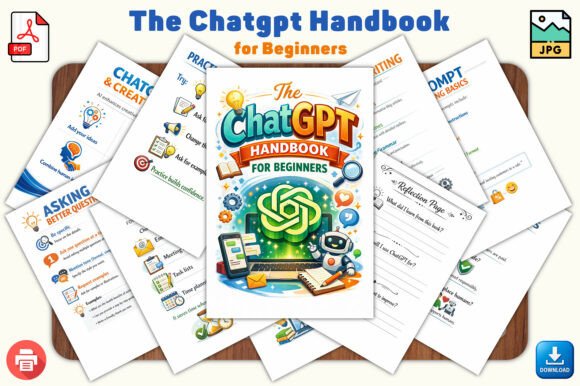
The ChatGPT Handbook for Beginners
If you have ever stared at a blank ChatGPT input box wondering what to type, you are not alone. Many graphic designers and creatives feel the same frustration—AI sounds powerful, but without a clear strategy, it often delivers generic, unusable results. That is exactly where The ChatGPT Handbook for Beginners steps in, transforming confusion into a practical tool for your design workflow.
This handbook is not a dry technical manual. It is a straightforward, beginner-friendly guide that teaches you how to understand ChatGPT from scratch and apply it to real creative projects. Whether you are designing a logo, building a brand identity, or crafting social media graphics, learning how prompts work and how to avoid common mistakes can save hours and elevate your output.
Why Designers Need a Practical Foundation
Artificial intelligence is rapidly changing how we approach visual design. Yet many designers struggle to integrate AI meaningfully because they do not know what to ask or how to refine responses. The handbook breaks this barrier by explaining what ChatGPT can and cannot do, focusing on practical applications like generating design briefs, brainstorming color palettes, or drafting copy for marketing materials.
When you understand the mechanics behind effective prompts, you gain the ability to direct AI toward consistent, on-brand results. This is especially valuable when working on branding projects where every element—from typography to visual hierarchy—needs to align with a cohesive brand identity.
Applications Across Your Design Workflow
- Branding and logo design – Use ChatGPT to generate brand personality statements, tagline options, and mood board descriptions that guide your visual choices.
- Marketing materials – Quickly draft headlines, product descriptions, and call-to-action text for brochures or ads.
- Social media graphics – Ask for caption ideas, hashtag strategies, or even image style prompts for tools like Midjourney.
- Web and UI design – Get suggestions for navigation labels, microcopy, and user flow descriptions.
- Editorial layouts – Generate article summaries, pull quotes, and alternative headlines.
- Packaging design – Brainstorm product names and descriptive copy that reinforces shelf appeal.
- Presentations and digital products – Outline slide decks or create structured content for online courses.
Each of these applications benefits from the handbook's emphasis on prompt writing basics and safe, responsible use. Instead of treating AI like a magic wand, you learn to treat it like a junior collaborator who needs clear direction.
Building Visual Consistency with AI
One of the biggest challenges in graphic design is maintaining consistency across multiple assets. A well-trained designer knows that color palette, typography, and composition must work together. The ChatGPT Handbook for Beginners shows you how to craft prompts that reinforce these design principles. For example, you can ask ChatGPT to generate descriptions that match your existing brand guidelines, or to suggest alternative approaches while keeping readability and scalability in mind.
By using AI as a brainstorming partner, you free up mental energy to focus on high-level decisions like visual hierarchy, modern aesthetics, and creative direction. This efficiency is especially useful when juggling multiple projects or tight deadlines.
Selecting and Evaluating Design Elements
Beyond generating text, the handbook teaches you to evaluate AI output critically. When you request a description for a logo concept or a mood board theme, you learn to assess how well it aligns with audience expectations and design goals. Key factors to consider include:
- Consistency – Does the output match your brand voice and visual identity?
- Readability – Is the suggested copy appropriate for its intended medium?
- Scalability – Will the idea work across print, web, and mobile?
- Compatibility – Does it fit within existing brand systems without feeling disjointed?
These evaluation skills are essential for any designer who wants to use AI responsibly without losing creative control.
From Confusion to Confident Creation
The real value of The ChatGPT Handbook for Beginners lies in its ability to turn uncertainty into action. You do not need to be a technical wizard or a prompt engineer. You simply need curiosity and a willingness to experiment. The book walks you through safety, ethics, and practical use cases so that you can apply ChatGPT in daily life, work, study, and creative projects without stress.
Imagine spending less time staring at a blinking cursor and more time refining your design portfolio, experimenting with typography, or exploring new creative assets. That shift in workflow can dramatically improve your productivity and the quality of your output.
Ultimately, thoughtful design choices still depend on your expertise. AI is a tool, not a replacement. But when you understand how to guide it effectively, you amplify your ability to create polished, professional presentations, memorable brand identities, and engaging visual content. The handbook gives you that foundation—simple, practical, and immediately useful.
Whether you are a solo freelancer, a marketing professional, or part of an in-house creative team, mastering the basics of ChatGPT will help you save time, reduce frustration, and produce work that stands out. Start with clarity, and let the AI handle the rest.